


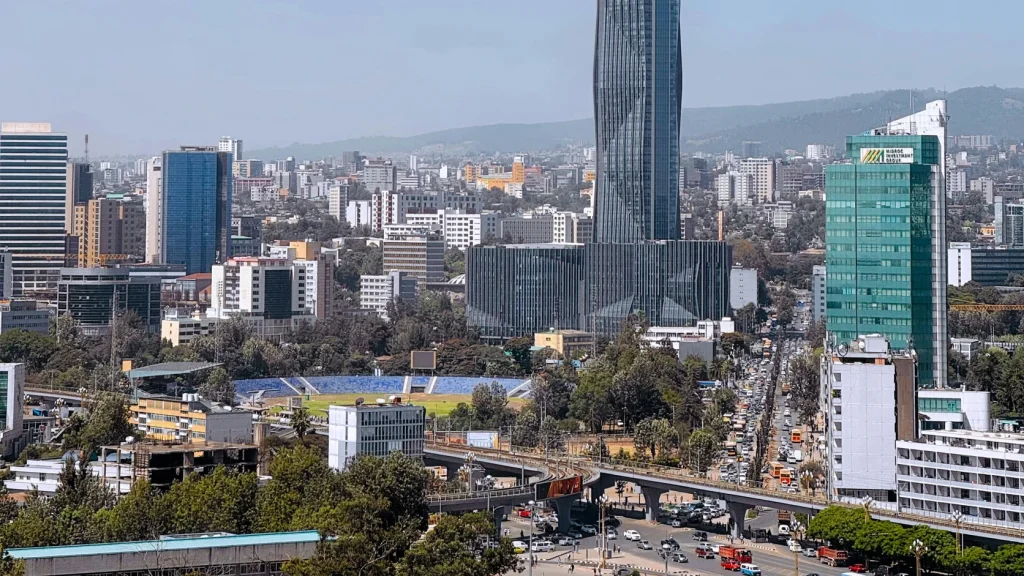
Addis Ababa wants to flip a habit that’s cost Ethiopia money and patients for years: sending its own people abroad to get well.
Mayor Adanech Abiebie said this month that the city will “fully realize, within the next five years,” a plan to become somewhere “people can rely on for medical treatment.” She wasn’t talking only about the roughly five million residents of Ethiopia’s capital. She meant Ethiopians from other regions, foreign nationals already living in the city, and visitors who might otherwise fly to New Delhi or Bangkok for care instead.
That’s an ambitious timeline for a health system still building out the basics. A few pieces are already in place.
A PET scanner and a bigger ambition
Lafto Specialized Hospital in Addis Ababa recently brought in a PET scanner, a machine that combines imaging with tracer chemistry to spot cancer and heart disease with more precision than a standard CT scan. Until now, East African patients who needed one generally had to fly to Kenya. A handful of private Ethiopian hospitals have since acquired the same technology, following government incentives meant to pull equipment — and expertise — into the country rather than send patients out of it.
It’s one machine, in one hospital, in one city. It’s also the clearest evidence so far that the plan has moved past a press release.
Elsewhere in Addis Ababa, Addis Hiwot General Hospital is building a 16-story facility on roughly 1,400 square meters of land, with plans for radiotherapy, organ transplant capacity, and in vitro fertilization once complete. Ethiopia’s government has also started offering discounted land leases and duty-free imports for medical equipment to hospitals willing to invest, along with easier access to foreign currency for buying supplies — a persistent bottleneck in a country where hard currency is tightly managed.
The money Ethiopia is trying to keep home
Ethiopian health officials have been making this argument for a couple of years now, and the mayor’s plan gives it a deadline. Prof. Miliard Derbew, a longtime voice in the country’s health sector, has said plainly that “many Ethiopians continue to travel abroad for treatments that could be provided locally.” Dr. Kassahun Kiros has made a related point about the cost: outbound medical travel drives a “substantial outflow of foreign currency,” money that leaves the country and doesn’t come back.
Ethiopia already draws some regional patients — from Eritrea, Djibouti, Somalia, and Sudan — mostly for hepatobiliary conditions, intestinal disease, and cancer treatment. Addis Ababa’s hospitals have also brought in specialists from Thailand, India, Turkey, and South Africa to work alongside local doctors, trading patients going abroad for expertise coming in.
Kiros has also pointed to something less clinical: Addis Ababa’s climate. At roughly 2,350 meters above sea level, the city stays mild and temperate year-round, which he’s argued makes it a genuinely pleasant place to recover from surgery — a small but real selling point next to competitors baking in tropical heat or shivering through a Turkish winter.
Ethiopia isn’t the only country making this bet
Addis Ababa is entering a field where other African cities have already staked a claim. Kenya has spent recent years positioning Nairobi as a regional hub, with Aga Khan University Hospital among the institutions pushing to draw patients back from overseas. The prize they’re chasing is real money: the African Export-Import Bank estimates the continent loses about $7 billion a year as patients travel abroad for care they can’t get, or don’t trust, at home.
India alone receives more than 300,000 African patients a year, drawn by lower costs and a wide bench of specialists. Part of the reason is a stark shortage back home — the continent has roughly one cardiologist for every 600,000 people, a gap no single new hospital wing closes on its own.
That number confirms the demand is real. It also means Addis Ababa isn’t only up against Bangkok or Istanbul — it’s up against Nairobi, and against every other African capital chasing the same patients.
What five years actually has to cover
Mayor Abiebie was specific about what the plan requires: “clearly identifying priorities, giving them due attention, planning with commitment, and working in coordination.” Officials say some version of that about almost every ambitious target. The gap between saying it and doing it is where most five-year health plans stall.
Medical tourism isn’t just imaging equipment and hospital towers. Patients who fly internationally for care look for accreditation, malpractice recourse, and continuity of care once they’ve gone home — questions Addis Ababa hasn’t answered publicly yet. Ethiopia’s Food and Medicine Authority and the Ministry of Health would need international-grade accreditation systems, not just domestic sign-off, before insurers or patients abroad trust the label.
None of that shows up in a five-year target announced to local press. It shows up later, in whether a patient from Djibouti — or a patient from much further away, if the plan holds — feels safe enough to book the flight.
For now, Addis Ababa has a mayor’s public commitment, one new scanner, one hospital tower under construction, and a regional market worth billions that isn’t waiting for anyone to catch up.