


China’s medical travel market combines international patient services, substantial domestic travel and a policy experiment in Hainan. Those activities need to be measured separately.
China is difficult to describe with a single medical tourism headline. A foreign resident using a Shanghai clinic, a mainland resident travelling to Hainan for an imported medicine and a patient flying from another country for surgery are three different customers. They may appear together in promotional accounts, but they represent different markets.
For hospital operators and investors, the question is which of these markets a service can realistically reach. For patients, it is whether a particular team can provide appropriate treatment, understandable consent and dependable follow-up. China’s healthcare scale does not answer either question on its own.
Country guide · Destination Intelligence · Research updated 17 October 2026. Historical figures are labelled by period. This profile covers mainland China; Hong Kong and Macao have separate healthcare and immigration systems.


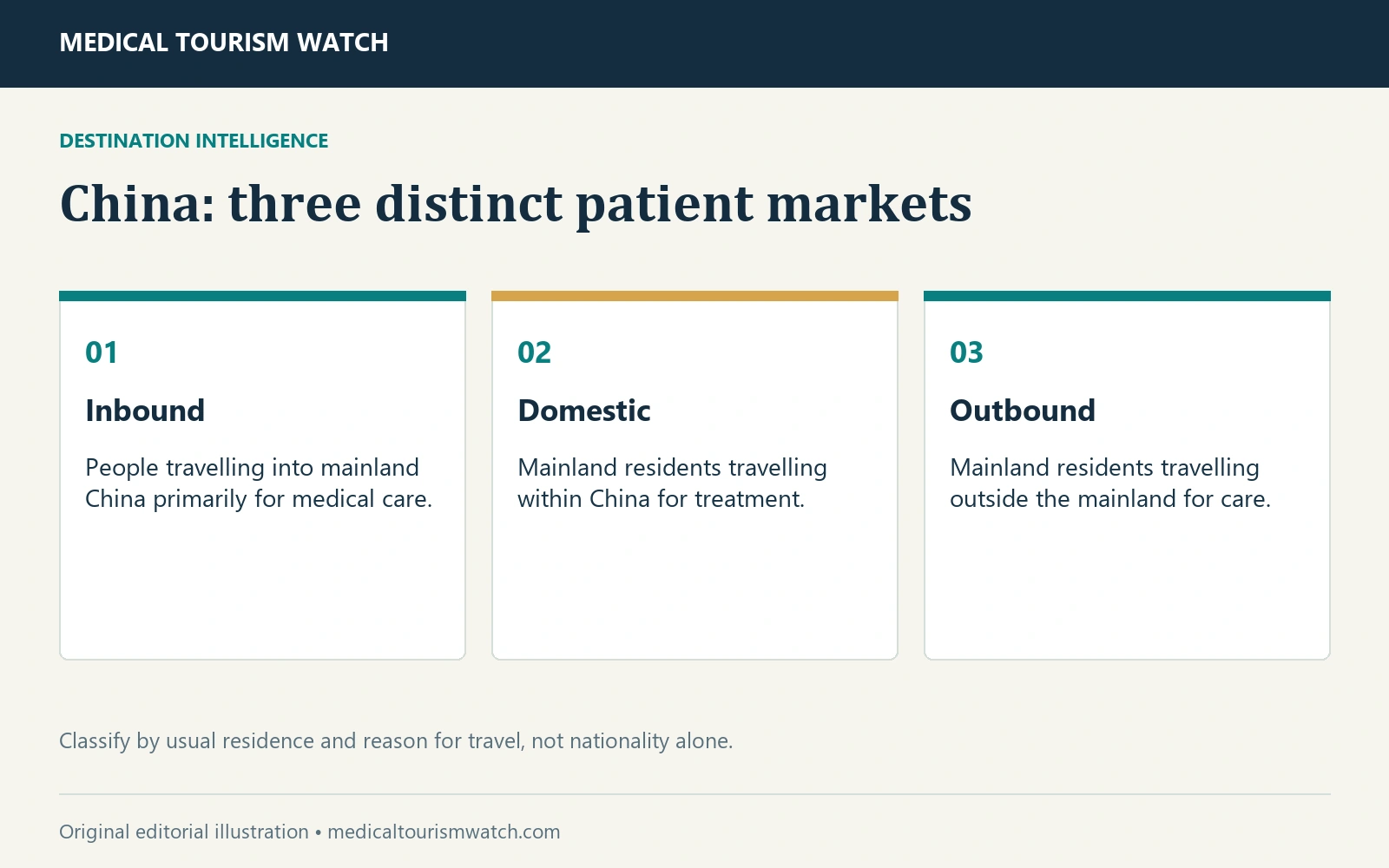
What counts as medical tourism in China?
In this profile, inbound medical tourism means a person who normally lives outside mainland China travelling there primarily for medical care. Outbound medical tourism means a mainland resident travelling outside the mainland for care. Domestic medical travel means travelling within the mainland for treatment.
Foreign nationality alone does not establish inbound medical tourism. International hospital departments also serve expatriates, business travellers and people who become ill during a holiday. Equally, an international drug used in Hainan does not make its Chinese recipient an international visitor.
Wellness travel overlaps with healthcare when a licensed clinician provides a medical intervention. A spa stay, general fitness programme or tourism itinerary should not automatically be counted as a medical treatment episode. The boundary matters when someone presents a large “health tourism” market estimate.
The market evidence: Hainan shows why definitions matter
Hainan’s government reported 865,300 medical tourism visits to Boao Lecheng in 2025. A separate June 2026 service-centre announcement reported nearly 10,000 inbound medical tourists from 14 countries and regions during 2025.
These are distinct published measures, not interchangeable estimates of foreign patient arrivals. They also should not be divided to produce a precise international market share without confirming how each series treats repeat visits, residence and treatment purpose. Neither number is a national total for China.
The sources reviewed for this profile do not establish a comparable, nationwide count of unique inbound medical tourists or outbound medical travellers. Commercial forecasts can be useful for understanding an analyst’s assumptions, but a forecast is not an observed patient count.
Inbound and outbound flows
Inbound demand needs to be investigated by treatment and referral channel. A specialist hospital receiving overseas referrals operates differently from a clinic serving expatriates or a wellness provider selling holiday packages. Language, flight access, insurance arrangements and an existing connection to China can affect a patient’s decision as much as the treatment price.
For outbound travel, the useful questions are what patients seek abroad and why domestic care does not meet that need. These can include a second opinion, access to a particular specialist, a treatment pathway or a preferred care environment. This profile does not assign numerical shares to those motivations because the reviewed public evidence does not support them.
Lecheng introduces an additional possibility: some demand for overseas-approved products may be served inside China. That is a potential substitution mechanism, not proof that outbound travel has fallen. Demonstrating substitution would require patient-level evidence about what people would otherwise have done.
Cities and the provider landscape
| Location | What to investigate | Important distinction |
|---|---|---|
| Beijing and Tianjin | Specialist referral services, public hospital international departments and private providers | A famous institution may have different appointment, billing and language arrangements across departments. |
| Shanghai | Public hospital international services and private hospitals serving international patients | Resident international patients and people travelling specifically for treatment are separate markets. |
| Guangzhou and Shenzhen | Specific specialist teams and cross-border care arrangements | Confirm which jurisdiction, facility and clinician are responsible for each stage of care. |
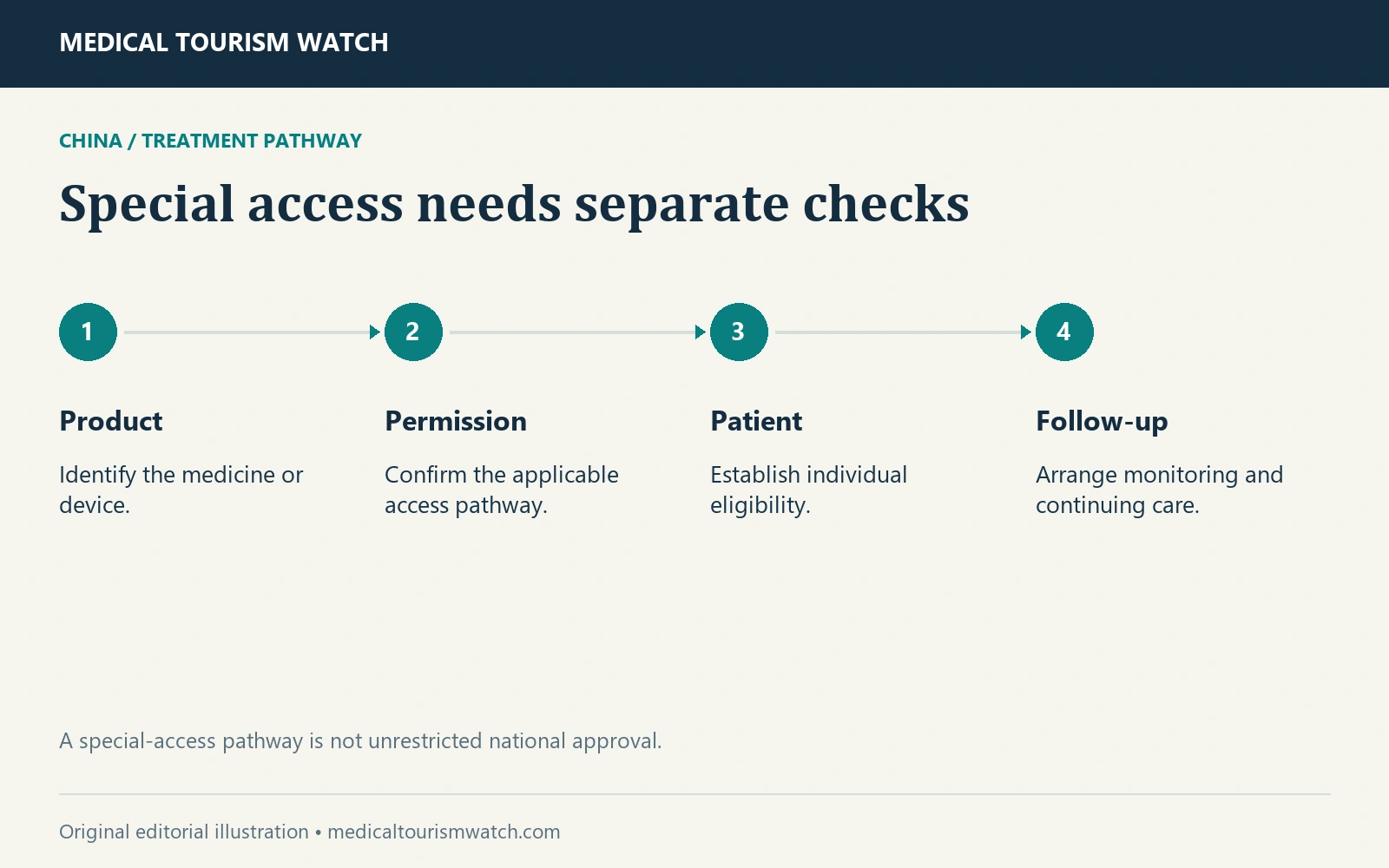
| Boao Lecheng, Hainan | Designated institutions and access to products under the zone’s special arrangements | Special access in the zone is not equivalent to unrestricted approval throughout China. |
This is a research map, not a ranking or an assertion about city market shares. Shanghai’s government described the selection of 13 public hospitals for an international medical tourism pilot in September 2024. The original announcement specified a two-year pilot; it should not be treated as proof of every hospital’s current programme status.
The provider landscape includes public hospitals, university-affiliated institutions, private hospitals and specialist clinics. Shanghai’s official service guide identifies private providers including Jiahui, United Family and SinoUnited. Their inclusion illustrates the market structure and is not an endorsement or verification of a particular service.
Treatments: evaluate the clinical pathway
A patient considering complex care should ask whether the receiving team will review existing scans, pathology, medicines and previous treatment before accepting a booking. The relevant unit of comparison is the clinical team and its facilities, not a general claim that a country is advanced in oncology, orthopaedics or another specialty.
Hainan’s official reporting describes services involving imported medicines and devices, screening, chronic-disease management and rehabilitation. Its July 2025 account of Lecheng explains that special policies allow access to certain products approved overseas but not yet generally available domestically.
For any such treatment, request the product name, indication, approval pathway, expected benefit, uncertainties and follow-up requirements. Ask whether the proposed use is standard treatment, off-label use, special access or participation in research. These categories have different implications for consent and evidence.
Traditional Chinese medicine should also be evaluated intervention by intervention. Cultural familiarity and a long history of use do not establish effectiveness for a particular diagnosis. Tell the treating team about all prescribed medicines and supplements, and obtain an explanation of how the proposed intervention fits into the overall care plan.
Regulation and provider verification
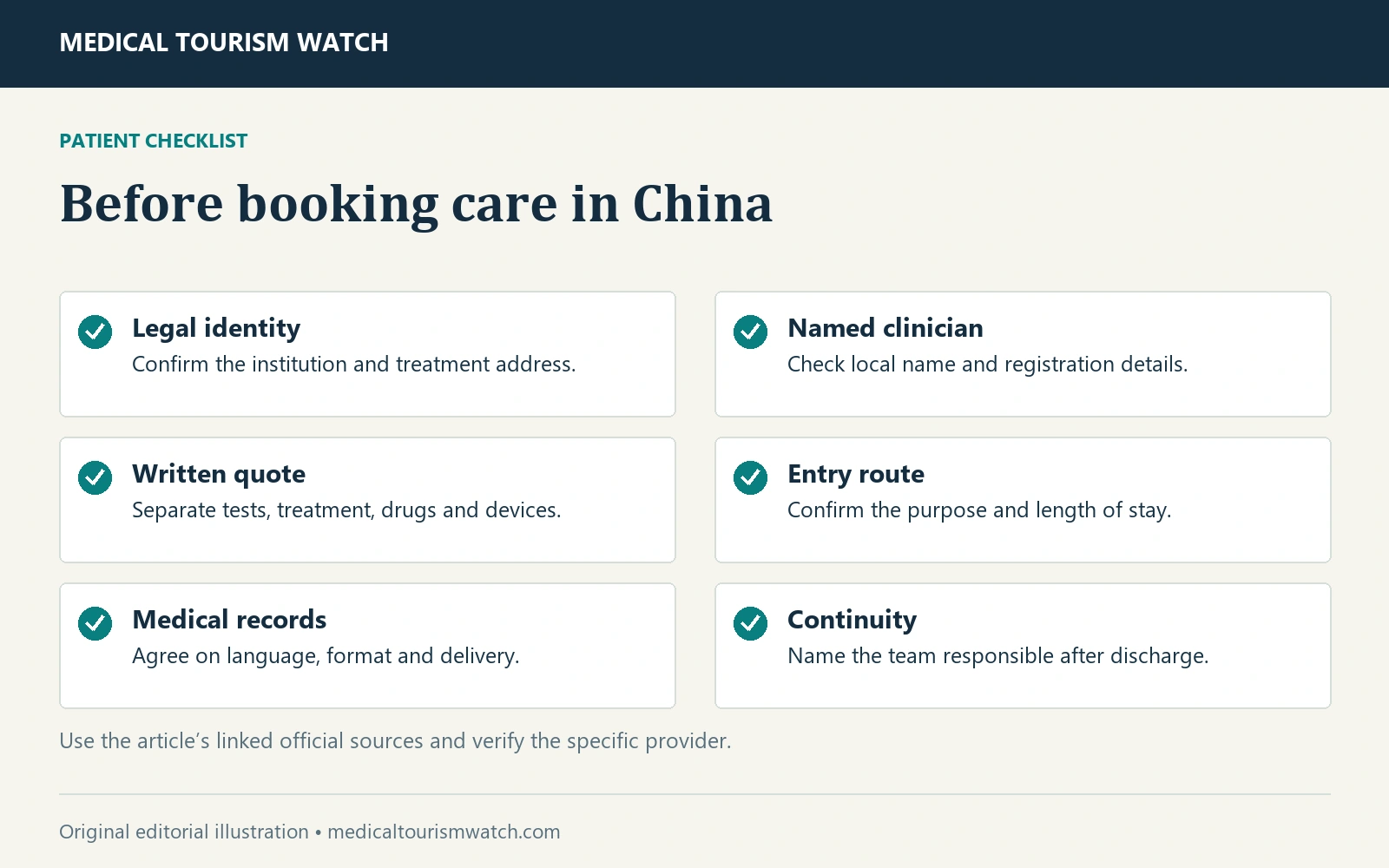
Begin with the legal Chinese name of the institution, its address and its medical institution licence. Ask for the treating doctor’s Chinese name and registration details. The National Health Commission provides institution and professional information-query routes. Searches may require Chinese-language details or further contact with the relevant health authority.
Check the specific branch and specialty. A group’s name, an international department or an academic affiliation does not independently establish permission for every advertised procedure. Where online information is incomplete, request written clarification instead of treating a failed search as proof of either legitimacy or wrongdoing.
China’s 2024 foreign-owned hospital pilot framework permits eligible wholly foreign-owned hospitals in specified cities and Hainan, subject to conditions. This is a market-access policy. It does not mean any foreign healthcare business can operate anywhere, or that foreign ownership certifies better clinical outcomes.
Indicative costs and what they actually buy
There is no defensible single “China treatment price” across ordinary public care, VIP departments and international private hospitals. The Shanghai government’s August 2025 service guide provides a limited illustration: it lists an ordinary city-level public outpatient registration fee of RMB 25, describes public VIP fees in the hundreds of yuan, and gives international hospital or clinic registration fees from several hundred to more than RMB 1,000.
These are published registration-fee indications, checked during this article’s research, not quotations for investigations, surgery or a complete treatment episode. They should not be multiplied into a surgical budget. They are also Shanghai examples, not national tariffs.
For substantive treatment, obtain a written estimate in renminbi separating clinician fees, diagnostic work, drugs, devices, anaesthesia, bed charges, interpretation and follow-up. Ask whether a deposit is refundable if examination changes the plan. Confirm who pays for additional treatment and whether an insurer’s apparent acceptance means direct billing or reimbursement after payment.
A transparent estimate may be more useful than a low advertised package. For example, two implant quotations are not comparable if one names the device and includes rehabilitation while the other covers only the operation. Imported-product access can also create continuing costs after the initial visit.
Visa and entry overview
Check the route appropriate to your passport, residence, treatment purpose and anticipated stay with the responsible Chinese embassy or visa centre. The S2 documentation guidance published by one Chinese visa centre includes hospital documentation for medical treatment. Requirements are mission-specific; this is an example of a route, not a universal instruction to apply for S2.
Do not assume a general visa waiver, transit arrangement or Hainan entry concession covers your planned medical stay. Obtain confirmation for accompanying relatives, repeated appointments and any extension. An appointment letter supports an application but does not guarantee admission to the country.
Safety, records and care after returning home
The practical challenge is continuity. Agree on the language and format of your discharge summary, prescriptions, imaging and device information before treatment. Confirm whether the overseas team will communicate directly with the clinician who will provide follow-up at home.
Ask where emergencies will be managed, who is available outside office hours and whether the proposed recovery accommodation has any clinical staffing. A hotel arranged by a coordinator should not be assumed to provide nursing care. Travel timing should follow individual medical advice rather than a package itinerary.
For more detailed checks, use our guides to choosing a hospital abroad and verifying a doctor abroad.
What the industry should watch
Three developments will make China’s market easier to assess: publication of residence-based international patient data, clearer reporting of services delivered through international departments, and evidence that special-access pathways translate into sustainable patient services.
Lecheng’s new international service centre is an operational development worth following. Whether it improves conversion, patient understanding and follow-up needs to be demonstrated through results. The same applies to foreign hospital investment: an opening announcement and an operating licence are milestones, but neither establishes a mature international referral business.
Sources and scope
This profile uses linked Chinese government and health-authority publications for policy, programme descriptions and reported figures. Price examples are limited to the published Shanghai service guide. It does not estimate national market size, rank providers or independently audit clinical outcomes. The distinction between domestic, inbound and outbound demand is the analytical framework used throughout.
This article provides general information, not a personal treatment recommendation. For regional context, see our Thailand and Türkiye market profiles.
Featured photograph: Shanghai skyline, China (2016). Photo: Adi Constantin / Wikimedia Commons, CC0. Resized for publication.