


Türkiye’s medical travel market is larger than its cosmetic-surgery image. Understanding it requires separating planned treatment from care during a holiday, and hospital services from the businesses that sell access to them.
Türkiye, also commonly searched for as Turkey, has a visible international healthcare offer spanning hospitals, dental practices, surgical clinics and intermediaries. For industry readers, the central questions concern the mix of patients, revenue, regulation and capacity. For patients, the practical questions concern the named clinician, treatment location, total cost and responsibility after discharge.
Those questions should be answered at provider level. A successful destination brand does not establish the quality of every clinic operating within it, while an adverse event at one facility does not provide a national complication rate.
Country guide · Destination Intelligence · Research updated 17 October 2026. Statistics retain their stated period; price illustrations are not international patient quotations.
What is being counted?
This profile uses inbound medical tourism to mean travel by people normally resident abroad primarily to obtain medical care in Türkiye. That can include Turkish citizens who live overseas. Citizenship and residence answer different questions.
“Tourist health” refers to healthcare needed by someone already visiting for another purpose. Domestic medical travel occurs within Türkiye. Outbound medical travel means residents going abroad for care. These categories should not be combined without explaining the scope.
The USHAŞ statistics page, citing TÜİK, reports 1,506,442 people visiting for healthcare and approximately US$3.023 billion in revenue for 2024. A 2026 Trade Ministry account describes about 1.4 million international patients and US$3 billion in revenue for 2025. The latter figures are rounded official statements, not an exact series reproduced here.
These measures should not be described as a count of operations or foreign citizens alone. Revenue also should not be divided by visitors and presented as a typical treatment price: different procedures, repeat services and spending definitions can change that interpretation.
Inbound demand and outbound flows
The market is better understood through channels than through an unsupported list of “top source countries.” Relevant channels include self-paying patients responding to clinic marketing, referrals to specialist hospitals, insurer or institutional arrangements, and people resident abroad returning to a familiar language and healthcare system.
Each channel produces different economics. A patient buying a dental package may compare several quotes directly. A complex hospital referral may depend on clinical acceptance, translated records and payment authorisation. A diaspora patient may organise care through relatives rather than an international marketing department.
Türkiye also has outbound medical travel, but the sources reviewed here do not establish a current, comparable national count or a reliable destination breakdown. It would be misleading to derive outbound demand from inbound statistics or assume that a large domestic hospital sector eliminates it.
For market research, ask providers to report residence, referral source, treatment category, unique patients and repeat visits separately. Nationality alone can obscure the distinction between residents, overseas citizens and visitors.
Cities, treatments and provider models
| Location | Research focus | What to verify |
|---|---|---|
| Istanbul | Hospital departments, specialist clinics, dentistry, hair restoration and surgical services | The actual treatment campus and clinical team behind the booking brand |
| Ankara | Public, university and private specialist hospital services | International patient acceptance, referral requirements and language support |
| Antalya | Medical services marketed alongside a major tourism destination | The distinction between hospital care, accommodation and ordinary tourism support |
| İzmir | Hospital and outpatient services, including dental and surgical enquiries | Facility authorisation, named clinicians and the arrangements for follow-up |
This table is an orientation tool, not a ranking of cities or a statistical estimate of their market shares. Start with the Ministry of Health’s authorised facility lists and assess the exact provider relevant to the proposed treatment.
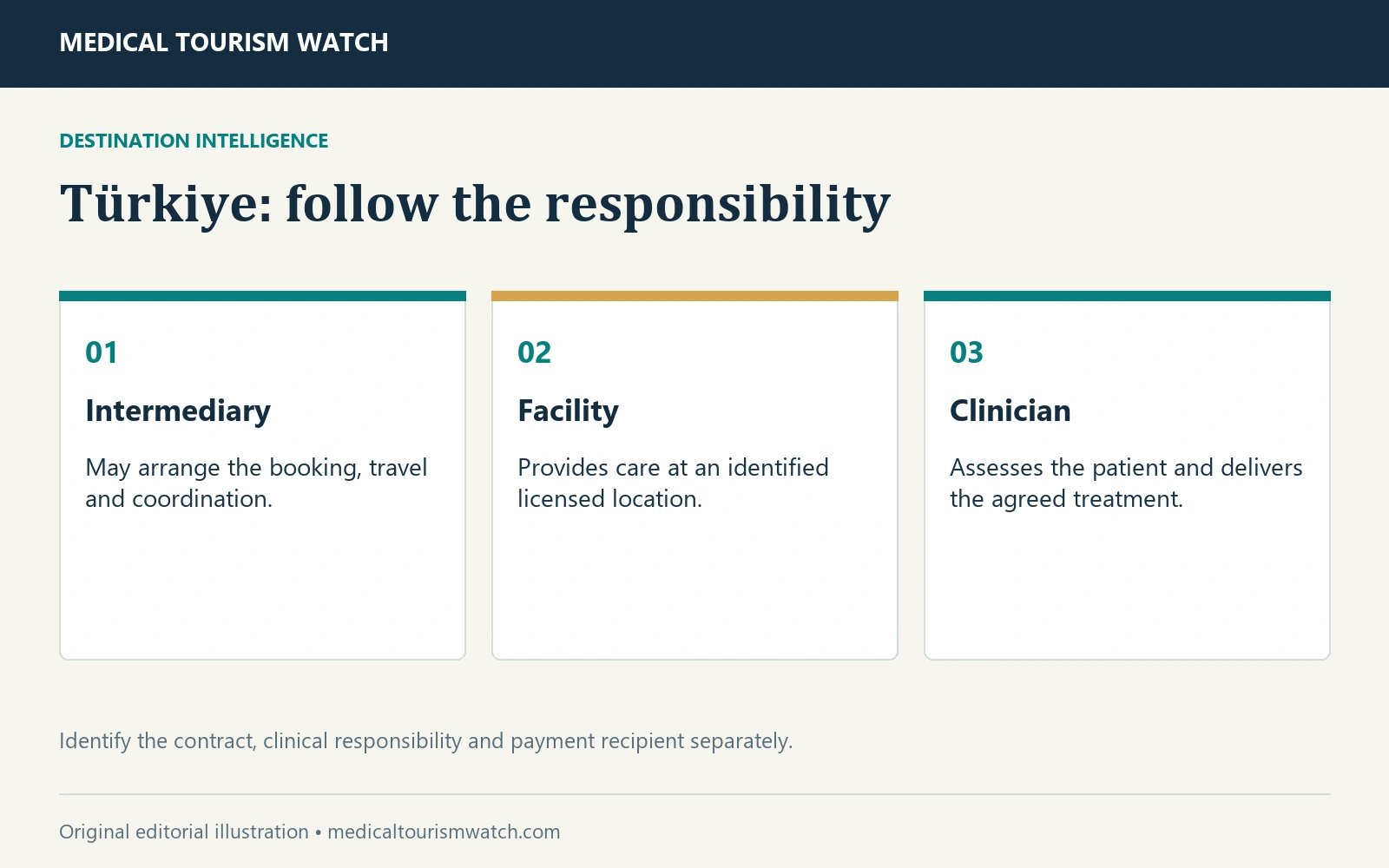
Hospital care and clinic-based packages should be analysed separately. A multidisciplinary hospital can support a different range of conditions from an outpatient dental practice. An intermediary may arrange a hospital service without employing the treating doctors. The customer-facing brand may therefore be different from the organisation legally responsible for clinical care.
In its Türkiye health advice, the UK government identifies cosmetic, dental and cardiac procedures among treatments sought by medical tourists. This does not establish their numerical shares. Hair restoration and other advertised services also require procedure-level checks rather than assumptions based on popularity.
Regulation: authorisation and the 2026 deadline
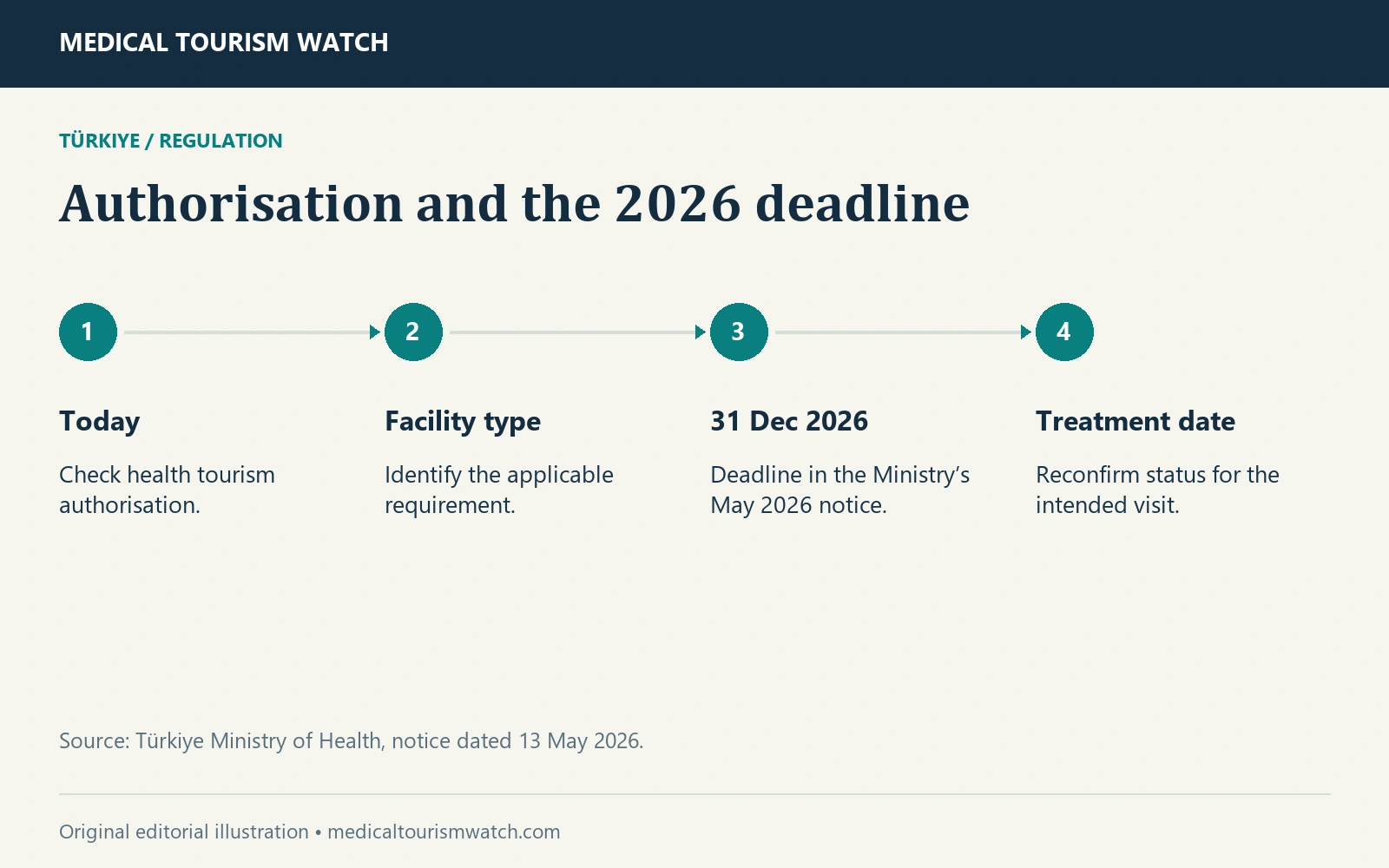
The 26 April 2025 regulation on international health tourism and tourist health sets a framework for healthcare facilities and intermediary organisations. Verify the current authorisation of each organisation involved; a travel business’s registration does not establish a hospital’s clinical permissions.
A Ministry notice dated 13 May 2026 states that authorised hospitals, laboratories, medical centres and dialysis centres must obtain TÜSKA accreditation by 31 December 2026. Other healthcare facilities must obtain the relevant certification through provincial health directorates. The notice says facilities that do not complete the process cannot continue providing international health tourism services after the deadline.
The distinction between an approaching deadline and completed compliance matters. As of this profile’s research date, the deadline is still ahead. Patients booking care across it should confirm the provider’s status for the intended treatment date. An existing authorisation certificate should not be represented as proof that every later requirement has already been met.
International accreditation, national authorisation and individual doctor registration are separate checks. A facility should be able to identify each credential accurately and explain which branch it covers.
How to check the hospital and doctor
Obtain the legal facility name, address and authorisation details before paying. Match these against the contract and proposed treatment location. If a coordinator changes the hospital after booking, reassess the new location rather than assuming that facilities are interchangeable.
For the clinician, request the full name, specialty and registration information. The Ministry’s Doctor Information Bank is one starting point, though access and verification procedures may require the professional’s cooperation. Use our doctor-verification guide for the distinction between a registered diploma, specialty status and permission to perform a procedure at a particular hospital.
Ask who will conduct the consultation, perform each clinical stage and handle complications. This is especially important when a package uses a prominent doctor’s photograph but describes the actual work only as being done by “our team.”
Indicative costs: a tariff is not a travel package
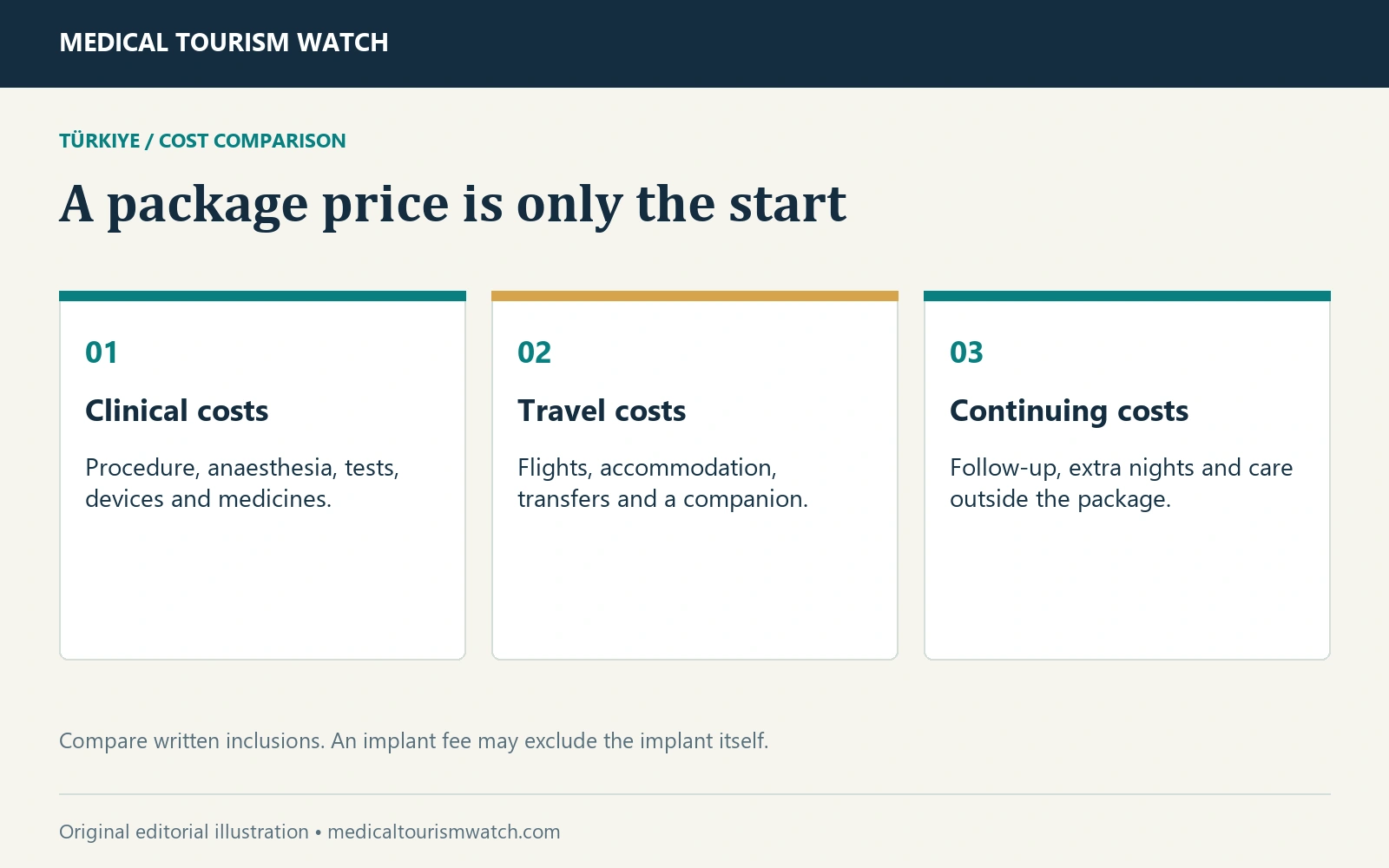
A useful published benchmark is the Turkish Dental Association’s 2026 dental fee guide. Its line for placement of a single cylindrical endosseous implant lists TRY 20,400 before VAT and TRY 22,440 including 10% VAT, explicitly excluding the implant itself. This is a professional fee-guide item, not a verified international package price or an all-in quotation.
The example demonstrates why apparently similar prices can represent different products. An implant treatment may also involve imaging, the implant component, an abutment, a crown, grafting where needed and more than one visit. Those elements need to be specified separately.
This profile does not publish a national “from” price for hair transplantation, cosmetic surgery or bariatric surgery. The reviewed evidence does not support a standardised, independently verified range with consistent inclusions. A low package headline would be less useful than an itemised quote for the actual procedure.
Ask whether the quote is fixed in Turkish lira, euros, sterling or dollars; who bears exchange-rate changes; and whether the amount includes taxes. Separate medical charges from accommodation, transfers and coordinator fees. Obtain written terms for extra nights, changed treatment plans, revision and complication care.
Budget for recovery and possible travel changes as well as the planned intervention. A cheaper initial operation can become a more expensive care episode if a second journey or additional treatment is required. That is a budgeting consideration, not a prediction that complications will occur.
Visa and entry overview
The Turkish Ministry of Foreign Affairs’ visa guidance lists medical-treatment and accompaniment purposes separately from tourist and business categories. The appropriate route depends on nationality, passport, residence, purpose and length of stay.
Do not assume that being eligible for tourist visa-free entry or an e-Visa settles the requirements for a planned medical stay. Describe the purpose accurately to the responsible consulate and confirm the position for an accompanying person. Ask the hospital for documentation of acceptance and the anticipated treatment period.
Leave room for clinical delays and check the process for any necessary extension. Visa validity, permitted length of stay and permission to re-enter are different matters. A hospital appointment is not a guarantee of entry.
Safety and aftercare
The UK’s official health advice warns that standards vary and that complications have occurred after medical procedures in Türkiye. It advises independent research and discussion with a home clinician. Such warnings should be read as a reason for careful assessment, not converted into an unsupported national risk percentage.
For surgery, clarify the anaesthesia arrangements, monitoring, emergency response and access to higher-level care. For dentistry, ask for the diagnosis, alternatives, materials and long-term maintenance plan. For every treatment, identify who will deal with a problem after the patient returns home.
A hotel room is accommodation unless clinical services are explicitly staffed and arranged. An airport transfer is transport, not medical clearance to travel. Agree on fitness-to-travel assessment and follow-up before choosing a return flight.
Keep the contract, consent documents, invoices and clinical records. Ask for a complaint process that identifies the responsible provider and authority. Package guarantees should be read for exclusions, time limits and the cost of returning for further treatment.
What the industry should watch
The immediate regulatory issue is how providers complete the accreditation or certification requirements before the end of 2026. Beyond compliance, useful indicators include the share of business from direct referrals versus intermediaries, changes in treatment mix and the availability of documented follow-up.
Revenue growth should be interpreted alongside patient volumes and case mix. A more complex treatment mix, different currencies or higher prices can alter revenue without demonstrating an improvement in patient numbers or outcomes.
Providers that disclose the clinical team, contract entity, total expected cost and aftercare responsibilities make meaningful comparison easier. Whether that transparency translates into a commercial advantage is a question for reporting and data, not something a country guide can assume.
Sources and scope
This profile draws on linked Turkish government sources, the Turkish Dental Association’s published fee guide and official travel-health advice. It uses historical statistics without forecasting a full-year 2026 total. It does not rank hospitals, provide a national complication rate or verify the quality of individual providers.
Continue with Choosing a Hospital Abroad, or compare the market structures described in our China and Thailand profiles.
Featured photograph: Istanbul waterfront and ferry, Türkiye (2025). Photo: SegLig / Wikimedia Commons, CC BY 4.0. Resized for publication.


