



Thailand’s medical travel business combines specialist hospital care, outpatient treatment and extensive international patient services. Its headline numbers need to be read carefully: non-Thai patients are not necessarily medical tourists.
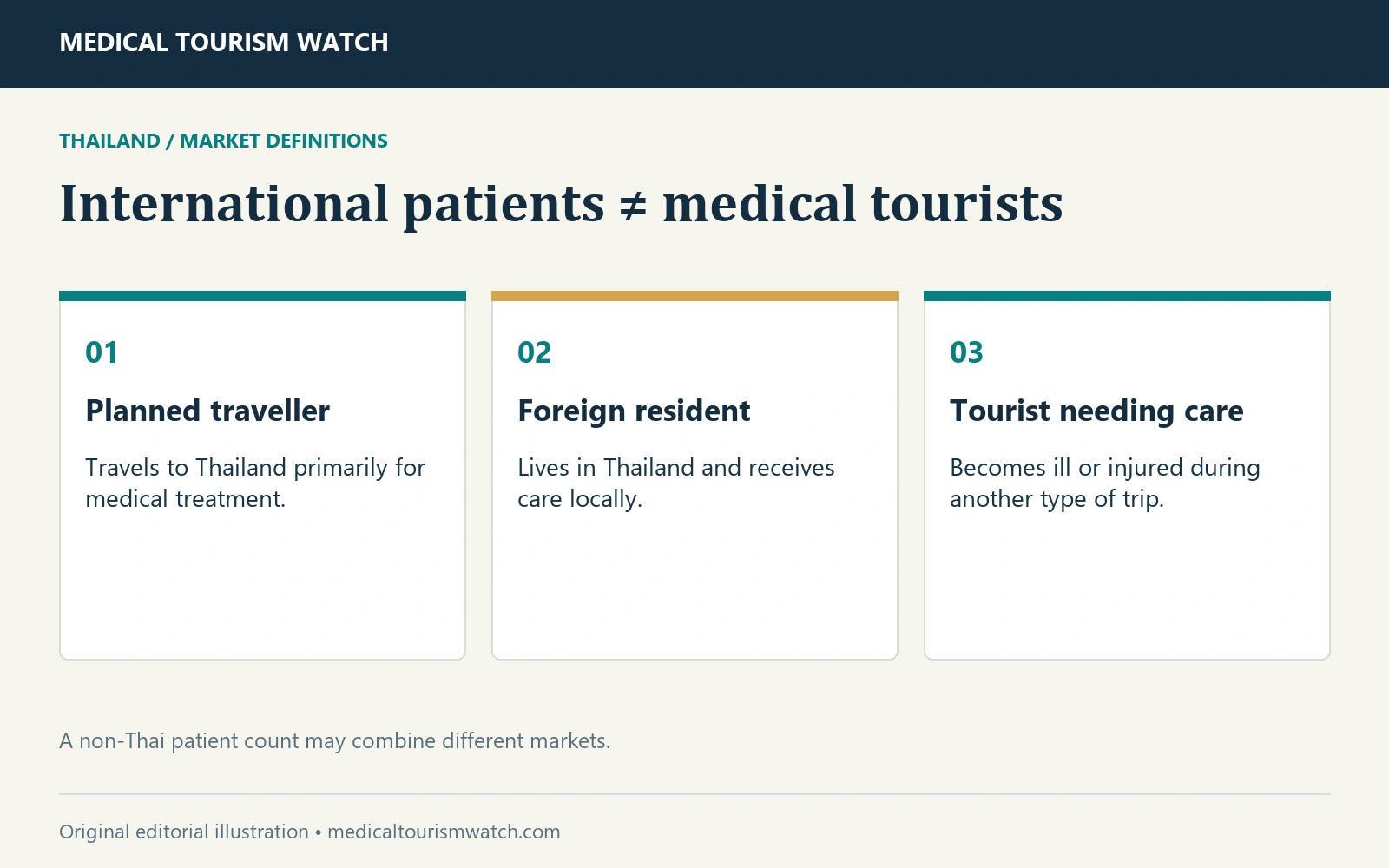
A Bangkok hospital treating a person who flew in for surgery, an expatriate attending a routine appointment and a holidaymaker with an unexpected illness may record all three as international patients. Their care is real, but only one clearly represents travel undertaken primarily for treatment.
That distinction shapes how Thailand should be assessed. For industry readers, hospital revenue and patient activity provide valuable evidence about particular businesses. For patients, the task is to assess a specific facility, clinician and treatment pathway rather than buy into a national reputation.
Country guide · Destination Intelligence · Research updated 17 October 2026. Company data are identified as company data. Advertised prices were checked on 17 October 2026.
Medical tourism, international patients and wellness
In this profile, an inbound medical tourist normally lives outside Thailand and travels there primarily for medical care. A foreign resident receiving local treatment is an international patient in some reporting systems but is not an inbound traveller for that episode.
Care needed unexpectedly during a holiday should be separated from planned treatment. Domestic medical travel involves residents travelling within Thailand; outbound medical travel involves residents seeking care abroad.
Wellness services also need a clear boundary. A spa, retreat or fitness stay may be a tourism product without a clinical intervention. When a programme includes medical screening, prescriptions or an invasive procedure, assess those components as healthcare. A wellness label does not make a medical intervention risk-free.
What the available numbers can show
Bumrungrad’s 2025 shareholder-meeting minutes report that non-Thai patients accounted for 65.7% of hospital-operation revenue in 2024. This describes one company’s revenue mix. It is not the share of Thailand’s healthcare revenue generated by medical tourism, or a count of people arriving for treatment.
BDMS’s 2026 meeting minutes report 5% growth in international patient income for 2025 and 11% when Cambodian patient income is excluded. That illustrates why source-market changes can matter to a hospital group. It should not be generalised into a national growth rate.
The public sources reviewed here do not establish a harmonised national count of unique travellers arriving primarily for treatment. Figures labelled visits, patients, non-Thai customers or medical tourists should be retained under their original definitions. Forecast market values belong in a separate category from measured revenue.
Inbound and outbound patient flows
Thailand’s international hospital business should be examined through regional referrals, longer-distance planned treatment, expatriate care and care for ordinary tourists. Combining these channels can conceal changes in the underlying market.
In a June 2025 company statement, Bumrungrad discussed patients from Cambodia, Laos, Myanmar and Middle Eastern markets alongside Thai and expatriate patients. This is evidence about the company’s account of its business, not an independently verified national ranking of source countries.
Hospitals can be affected differently by changes in a neighbouring country, an insurer’s network or an institutional referral agreement. To understand an operator, ask how much activity comes from each channel, what treatments those patients receive and whether the figures count repeat visits.
Outbound medical travel by Thai residents should also be treated as a separate market. The reviewed sources do not support a current national volume or destination ranking, so this profile does not supply one. A strong inbound sector does not establish that every treatment preference or specialist need is met domestically.
Cities and provider landscape
| Location | What to investigate | Practical issue |
|---|---|---|
| Bangkok | Large private hospitals, specialist departments and international patient offices | Compare the exact department and campus, including emergency and inpatient support. |
| Phuket | Hospital and clinic services in a major tourism destination | Separate planned treatment from tourist healthcare and recovery accommodation. |
| Chiang Mai | Hospital, outpatient and rehabilitation options | Confirm the clinical scope and arrangements for escalation or transfer. |
| Pattaya and the eastern seaboard | Services for residents, international patients and visitors | Check whether the quoted service is designed for fly-in patients or local residents. |
This table is an orientation aid, not a league table. The UK government’s healthcare directory for Thailand provides examples of facilities and services across the country, while expressly avoiding endorsement. Its existence should not replace current licensing checks.
The market includes large hospital groups, independent hospitals, specialist clinics and intermediaries. Bumrungrad and BDMS are useful analytical examples because they publish company information. Their inclusion here does not recommend either for an individual patient or establish that all their facilities have the same capabilities.
Treatments and clinical suitability
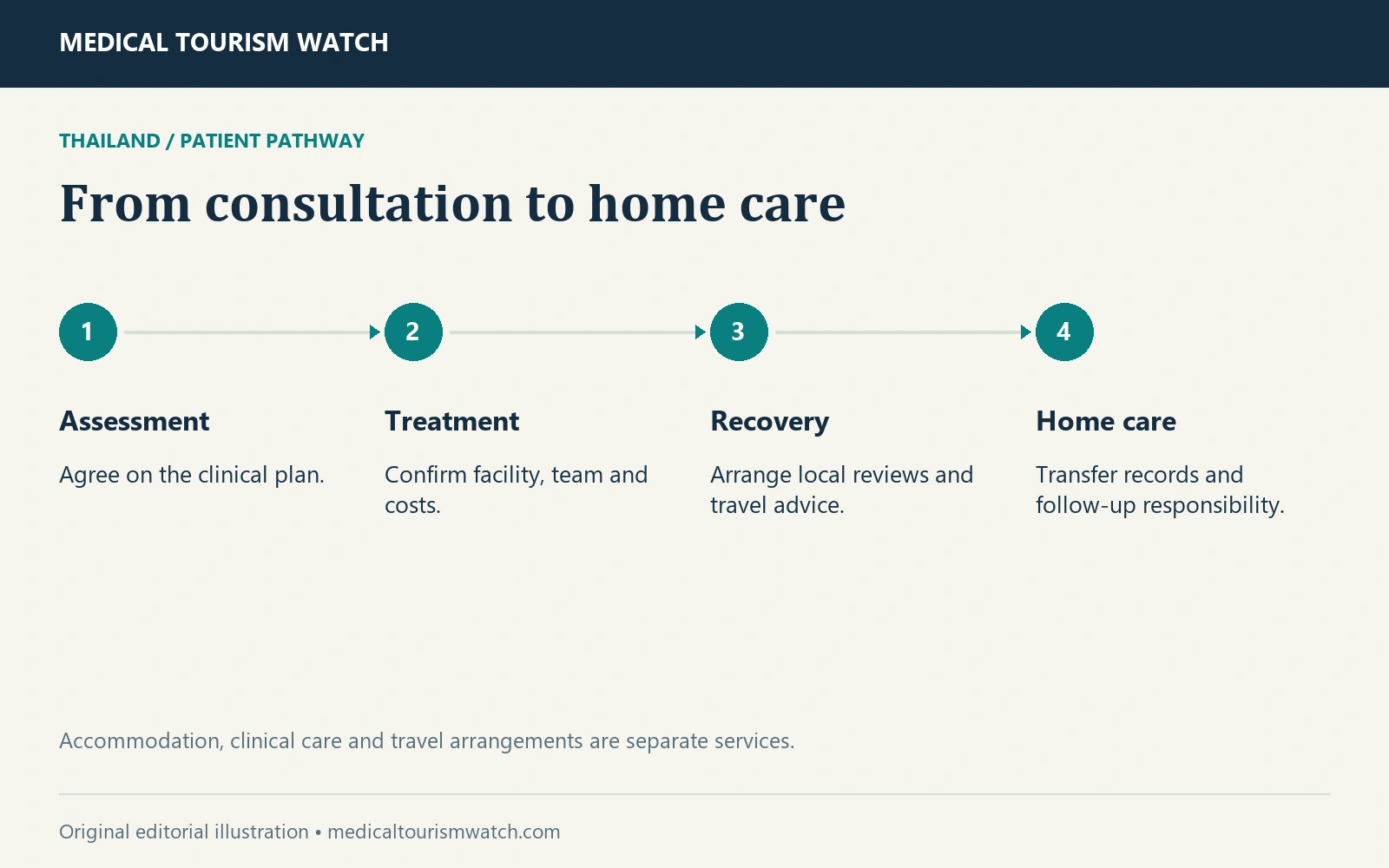
International-facing services can range from consultations and diagnostics to dental care, surgery and rehabilitation. The useful comparison is the full treatment pathway: who assesses the patient, what evidence supports the intervention, where it takes place and how continuing care is arranged.
Complex procedures require more than a convenient appointment. Ask about multidisciplinary review, the handling of existing medical conditions and the services available if the original plan changes. A package price should follow clinical acceptance rather than substitute for it.
Screening packages deserve similar scrutiny. More tests do not automatically produce greater benefit. Ask a clinician which tests are appropriate for your age, history and symptoms, how abnormal results will be investigated and what further costs may follow.
For programmes marketed around longevity, regeneration or novel therapies, request the exact intervention, regulatory status and evidence for the intended use. Separate hospitality benefits from clinical claims. Attractive surroundings do not resolve uncertainty about a medical product.
Regulation and checking providers
Start with the facility’s legal name, licence and treatment address. Thailand’s Department of Health Service Support provides a private hospital listing route. If a clinic or specific service cannot be confirmed through the available records, seek clarification from the responsible authority rather than relying on a translated marketing page.
The Medical Council of Thailand’s English search allows physician verification by name and, where supplied, medical licence number. Temporary permissions have a separate search route. Dentistry and other professions require the appropriate professional checks; a physician search is not a universal healthcare-worker register.
For drugs or devices, the Thai Food and Drug Administration’s electronic services provide product-related verification routes. A facility licence, a doctor’s registration and a product authorisation are separate matters. None alone establishes that a proposed intervention is suitable for you.
Accreditation can add information about organisational systems, but check the precise campus, programme and current status with the accrediting body. See our guides to hospital selection and doctor verification.
Indicative costs: a published hospital example
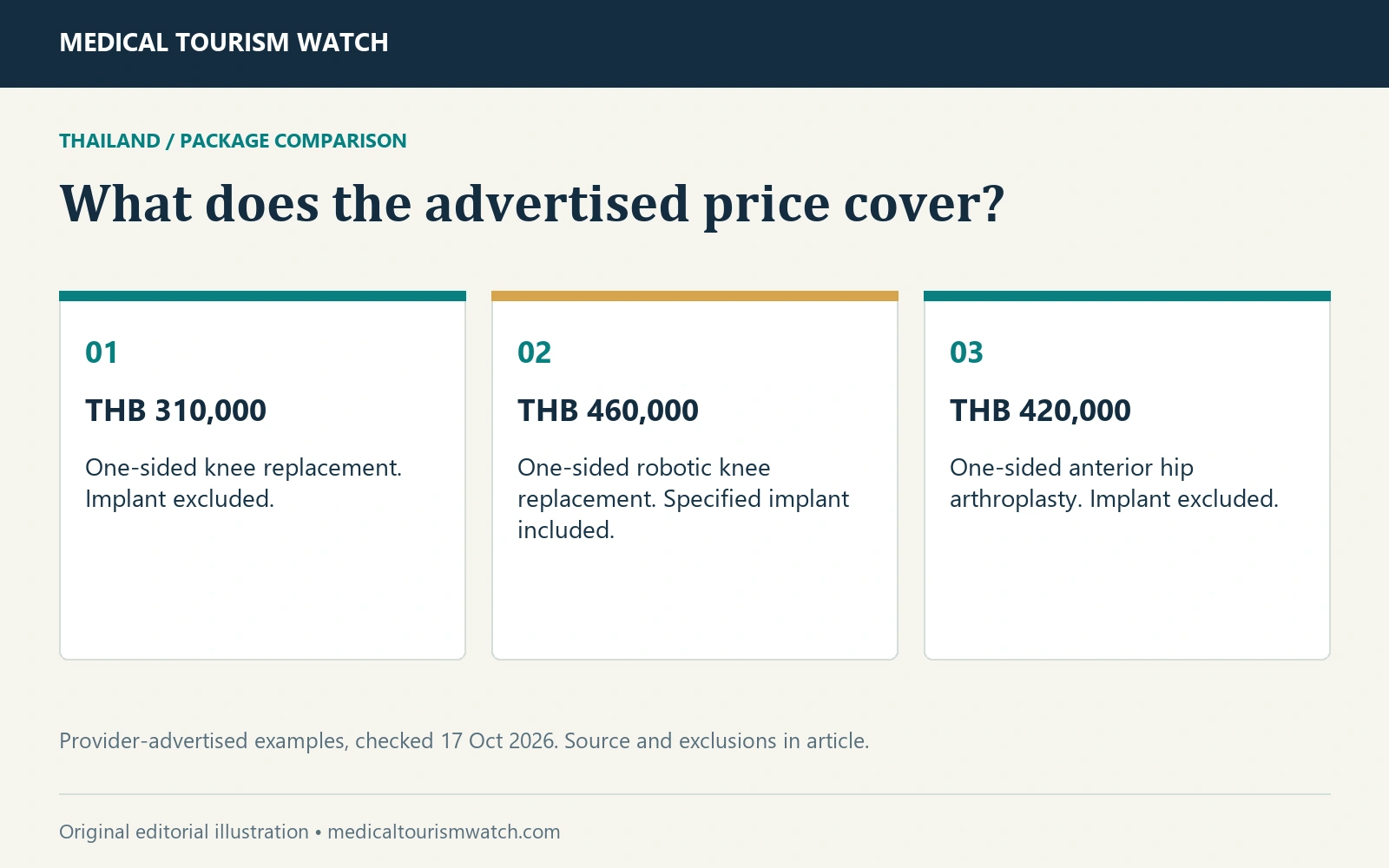
Bangkok International Hospital’s hip and knee package page, checked on 17 October 2026, advertises the following fly-in patient prices, with stated validity through 31 December 2026:
| Advertised procedure | Price | Key inclusion or exclusion |
|---|---|---|
| One-sided total knee replacement | THB 310,000 | Four hospital nights; implant excluded |
| One-sided robotic total knee replacement | THB 460,000 | Four hospital nights; specified implant included |
| One-sided direct anterior total hip arthroplasty | THB 420,000 | Four hospital nights; implant excluded |
These are provider-advertised examples, not independently audited final bills or national average prices. The page excludes several items, including preoperative medical clearance, certain specialist charges and treatment of complications or underlying conditions. It also reserves the right to change prices. Obtain a personalised written quote.
The larger budgeting lesson is to compare like with like. An implant-inclusive package cannot be assessed against an implant-excluding package by looking only at the headline. A specified hospital stay also does not tell you how long to remain locally before travelling.
Ask whether your quotation applies to a fly-in patient, a Thai resident, an expatriate or an insured patient. Add accommodation outside hospital, transport, an accompanying person where needed, rehabilitation and possible changes to the return journey. Keep the comparison in Thai baht until the payment and exchange-rate arrangements are clear.
Visa and entry overview
Use the official Thai e-Visa service and the embassy or consulate responsible for your place of residence to identify the correct route. The official portal distinguishes visa categories and includes medical-treatment purposes. The relevant requirements depend on nationality, residence, purpose and intended duration.
Do not rely on an old clinic blog’s description of visa-exempt stays. A general tourism permission should not be assumed to cover every medical itinerary. Explain the treatment and expected stay accurately, and confirm the position for companions and repeat visits.
Ask the hospital for an acceptance letter and a realistic treatment schedule. An application can require additional documents, and approval is not automatic. Build in time for assessment, recovery and any necessary extension rather than treating the original flight date as a clinical deadline.
Safety, recovery and follow-up
Ask who will review you after discharge and where urgent problems will be assessed. If the procedure is at a clinic, request the transfer plan and the receiving hospital’s role. If accommodation is described as a recovery facility, establish whether licensed clinical staff are actually present.
The UK government’s Thailand health guidance provides destination-health and medication information. Patients should also discuss their treatment and journey with their own clinician and insurer. Travel insurance, planned-treatment insurance and a hospital’s complication policy are different arrangements.
Request records in a usable language and format, including the procedure report, medicines, relevant results and implant details where applicable. Agree in advance on a clinician at home who can provide the necessary follow-up. A remote messaging channel may support that care but cannot always replace examination.
Recovery plans should account for the treatment and the journey. Sightseeing, swimming, long transfers or a tightly scheduled flight may conflict with clinical advice. The treating team should explain restrictions for the individual patient rather than offer a universal “safe to fly” interval.
What the industry should watch
Useful indicators include source-market concentration, referral agreements, the proportion of activity from foreign residents and the ability to retain patients through follow-up. Company revenue disclosures can reveal changes, but their definitions must remain attached to the numbers.
Pricing transparency is another test. A provider that clearly distinguishes resident and fly-in eligibility, devices, exclusions and follow-up makes the market easier to compare. The commercial significance should be assessed with evidence about enquiries, bookings and completed treatment rather than promotional visibility alone.
Thailand’s established international services are a business asset. The next analytical question is how consistently that infrastructure supports clinical communication, records and continuing care across different facilities and treatment types.
Sources and scope
This profile uses linked company disclosures for operator-level information, official verification and visa resources, and a dated provider price page. It does not extrapolate a national patient total from hospital figures or rank clinical quality. The price table is a small advertised snapshot, not a market survey.
For comparison, read our China and Türkiye profiles. Each uses the same distinction between medical travellers, other international patients and domestic care.
Featured photograph: Bangkok skyline at sunset, Thailand (2013). Photo: Azreey / Wikimedia Commons, CC BY-SA 3.0. Resized; image derivatives retain the same licence.


