



Choosing a hospital abroad means checking the facility, the clinical team and the entire care pathway. A recognised name or attractive package answers only part of the question.
The most useful opening question is not “Which country has the best hospitals?” It is “What evidence would show that this particular hospital can manage my treatment and its foreseeable complications?” That changes the search from a comparison of destinations to an assessment of care.
Medical travel can involve surgery, dentistry, diagnostics, fertility care, rehabilitation or specialist consultations. Some patients travel because of price; others seek access, shorter waits, a particular clinician or care in a familiar language. None of those reasons removes the need to examine how treatment will work before, during and after the trip.
Patient guide · Patient Safety & Ethics · Research updated 17 October 2026. This is a practical decision framework, not a hospital ranking or individual medical advice.
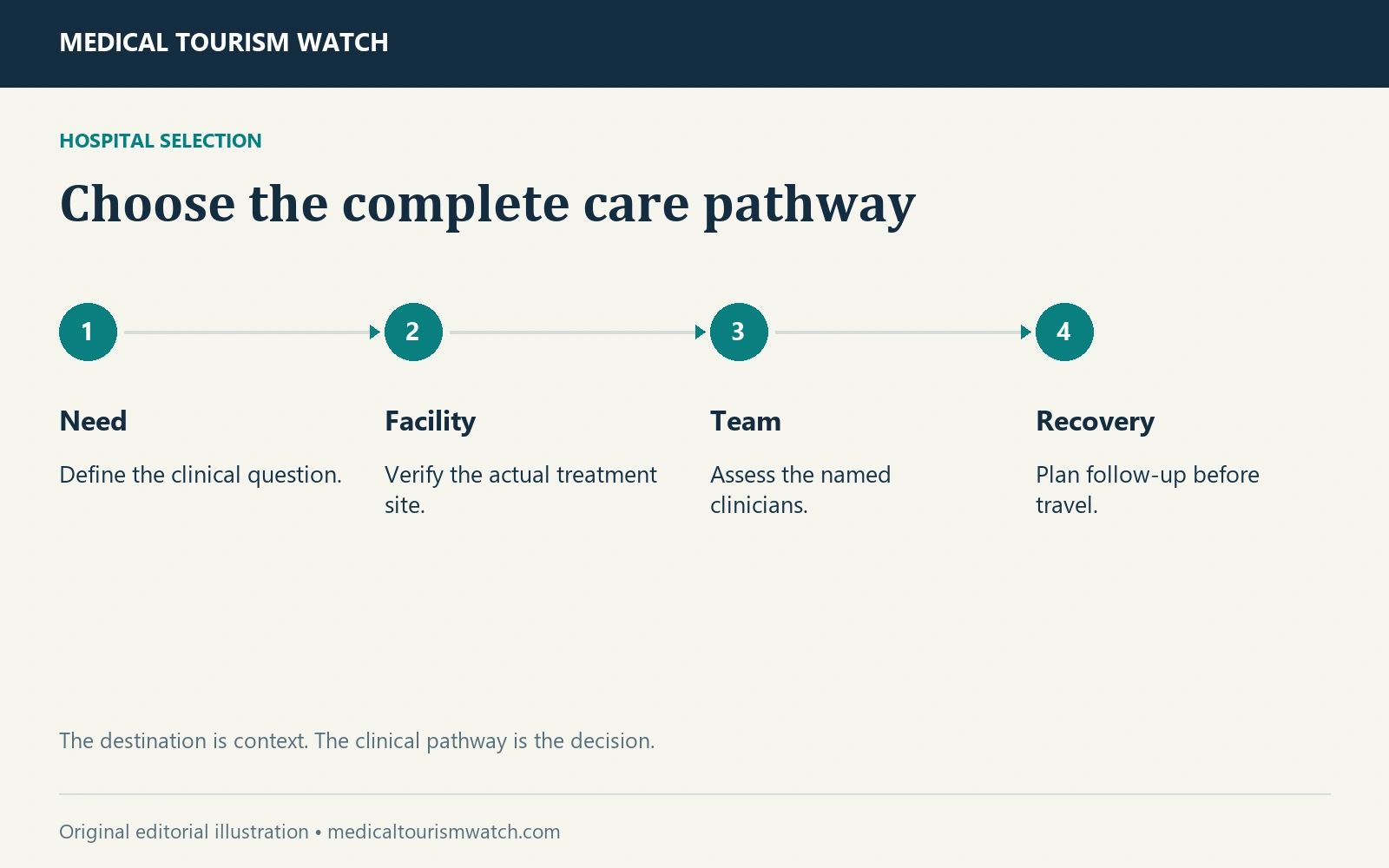
Start with the treatment decision
A hospital search should follow a clinical question. Ask a qualified clinician who understands your condition what needs to be established, which options are reasonable and what would happen if treatment were delayed or not undertaken. A destination package should not decide the procedure for you.
A useful referral summary includes the diagnosis or unresolved question, previous treatment, relevant investigations, current medicines and allergies. For a second opinion, clarify whether the receiving specialist needs original imaging or pathology material rather than a short translated report.
Before comparing hospitals, write down what you need: a consultation, a diagnostic assessment, a defined operation or a continuing course of care. These are different purchases. A price for an operation cannot answer the cost of an uncertain diagnosis that may require several specialists.
Understand what medical travel changes
People sought care away from home long before online booking platforms. Today’s hospital websites and intermediaries make international enquiries easier, but they can also compress a complex decision into a short sales conversation. Accessibility is not the same as clinical suitability.
Cross-border care adds handovers: between referring and receiving clinicians, between languages, between payment systems and between the treating team and whoever manages recovery. The hospital may perform its part well while the overall plan still fails because nobody has arranged follow-up.
The CDC’s medical tourism guidance identifies risks associated with overseas treatment, including infections and difficulties with continuity of care. It also cautions that accreditation does not guarantee a good outcome. The purpose of verification is to reduce avoidable uncertainty, not eliminate every medical risk.
Confirm the exact facility before discussing a deposit
Obtain the hospital’s legal name, street address, licence details and the name of the organisation issuing the treatment contract. Check the actual campus. A hospital group can have multiple sites with different services, teams and permissions.
Ask where the consultation, procedure, inpatient stay and follow-up will take place. If these are at different addresses, identify the responsible organisation at each stage. A clinic booking an operating room elsewhere should disclose that arrangement clearly.
Use the relevant regulator’s records wherever available. For example, Türkiye publishes health tourism authorisation information, China provides health institution query routes, and Thailand maintains a private hospital listing system. A listing should be checked for scope and current status; it is not a personalised recommendation.
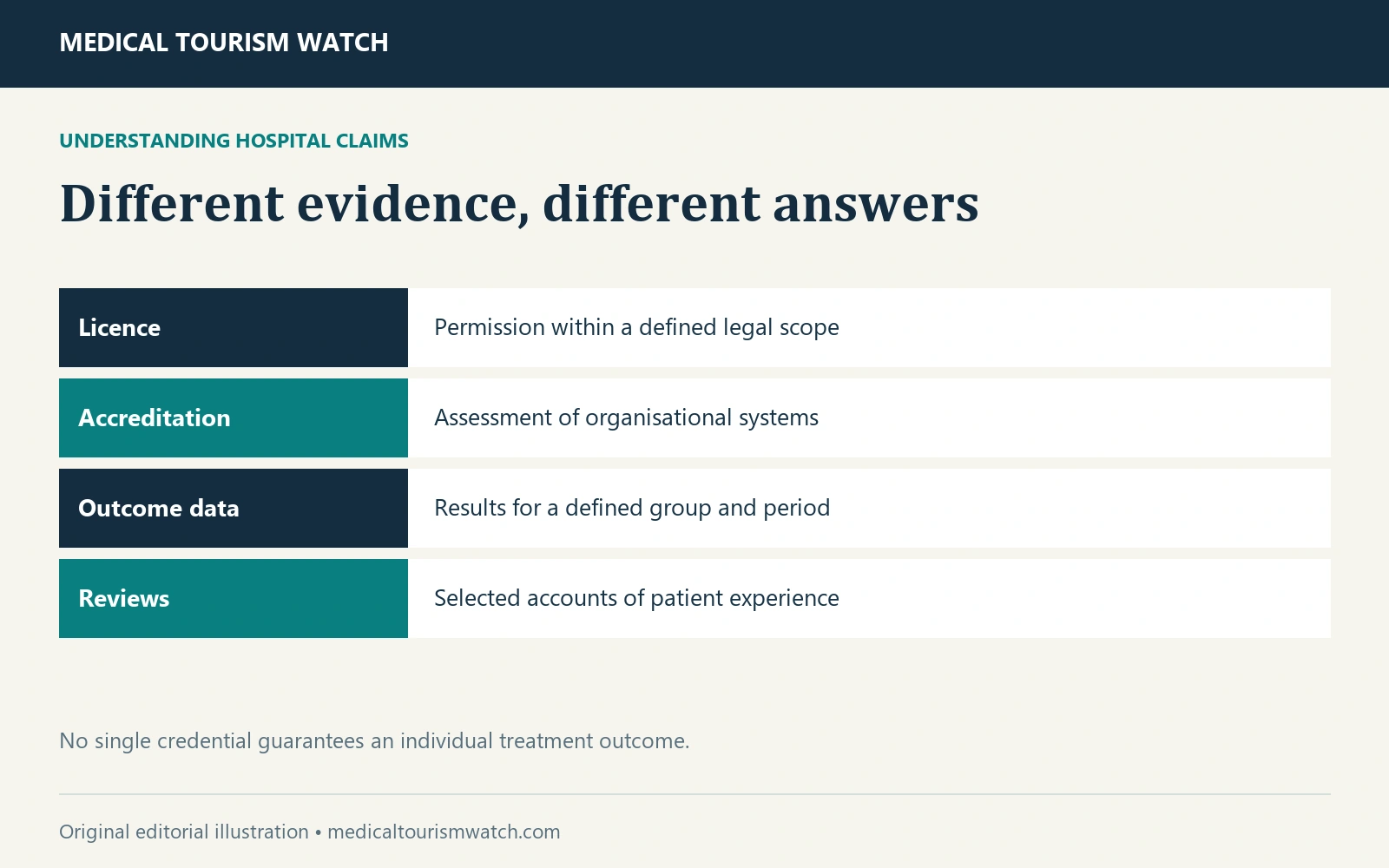
Separate licensing, accreditation and awards
| Evidence | What it can help establish | What it cannot establish alone |
|---|---|---|
| Facility licence | Permission to operate within the relevant legal scope | That every proposed procedure is suitable for you |
| Current accreditation | Assessment against a defined set of organisational standards | A guaranteed result or proof about every individual clinician |
| Specialty outcome data | Performance within a defined patient group and period | A fair comparison if definitions and case mix differ |
| Reviews and awards | Possible clues about experience or recognition | Reliable complication rates or legal authorisation |
Joint Commission International describes accreditation as an assessment of organisational quality and safety systems. If a hospital claims accreditation, verify the named organisation, campus, programme and status with the accreditor. An old certificate on a sales page is not enough.
Ask what an award actually measures. A reader vote, marketing award, management-system certification and clinical accreditation are different forms of recognition. A hospital should be able to explain which it has without suggesting that all are equivalent.
Assess the department and the people delivering care
Request the name of the clinician who will make the treatment decision and perform the main procedure. Ask whether that person has privileges to perform it at the named hospital. For an operation, identify the anaesthesia arrangements and who takes responsibility for inpatient care.
Our separate guide to verifying a doctor abroad explains registration, specialty qualifications and procedural experience. Hospital verification and doctor verification should support each other; neither replaces the other.
Questions about experience should be specific. “How many of these operations has this team performed recently?” is more useful than “How experienced is the hospital?” Ask whether the figures refer to the named clinician, the department or the entire group.
For complex treatment, ask how specialists reach a decision together. If the proposal involves several interventions, request the reason for each one and whether they must happen during the same trip. Adding procedures because travel has already been booked is not a clinical rationale.
Ask how the hospital manages complications
Request a plain-language account of the foreseeable problems for the proposed treatment and where they would be managed. Relevant questions include whether appropriate monitoring, emergency imaging, blood products, intensive care or specialist support are available when needed.
Not every treatment needs a large hospital. A suitable outpatient setting may be appropriate for some care, while other procedures require more support. Ask the treating clinician to explain why the proposed setting is appropriate for your medical history and procedure.
If transfer is the plan, establish which hospital would receive you, who arranges transport and how payment is handled. A claim that an emergency hospital is “nearby” does not describe a working transfer arrangement.
Ask who covers nights and weekends and whether the named surgeon remains available after discharge. A coordinator who answers messages is useful, but that service is different from access to a clinician who can assess a complication.
Read outcomes carefully
A success rate needs a definition. Ask what outcome was measured, over what period, in how many patients and with what follow-up. A patient leaving hospital without an immediate problem is not the same measure as recovery six months later.
Ask how missing follow-up is handled, particularly for patients who return overseas. A service cannot confidently count someone as complication-free merely because that person stopped replying. Find out whether the figures include patients transferred to other hospitals.
Comparison also requires context. A specialist centre treating more difficult cases may have different raw outcomes from a clinic accepting only low-risk patients. Lack of public outcome data does not itself prove poor care, but it limits what can be independently established. Record the limitation rather than replacing missing evidence with reviews.
Compare the complete cost
Ask for an itemised estimate showing the procedure, clinician fees, anaesthesia, investigations, implants or other devices, room category, expected stay and routine follow-up. Check the currency, validity period, taxes and exchange-rate arrangements.
Then request a separate explanation of exclusions. Additional diagnostics, treatment of existing conditions, extra inpatient nights, revision procedures and complication care can change the total. Ask how additional costs will be approved if you are unable to make decisions yourself.
Build a budget that also includes travel, accommodation, an accompanying person where needed, changed flights and care after returning home. There is no universal contingency percentage that makes every procedure financially safe. The size of the reserve should reflect the actual risks and insurance terms.
A hypothetical comparison illustrates the problem: a 6,000-unit surgical package with an unspecified implant cannot be fairly compared with a 7,000-unit package that includes the named implant, rehabilitation and follow-up. These are examples, not market prices. First make the contents comparable; then compare totals.
Check insurance and contracts before payment
Ask your insurer in writing about planned treatment, complications, emergency care, evacuation and follow-up. A policy that covers an unexpected illness during a holiday may exclude a trip taken for treatment. The CDC’s guidance on care abroad recommends confirming coverage and any additional insurance requirements before travel.
Clarify whether the hospital needs a deposit or an insurer’s guarantee of payment. Direct billing is an administrative arrangement; it does not mean every charge is covered. Ask what happens if the insurer disputes a bill.
Read the cancellation and refund terms, including what happens if the clinician advises against treatment after examination. Identify the legal entity receiving money and the complaint route. For a substantial or complex contract, consider independent legal advice about jurisdiction and enforceability rather than assuming your home-country protections apply overseas.
Make consent and communication workable
Meet the treating clinician before committing to an irreversible intervention. A consultation should explain the diagnosis, proposed treatment, reasonable alternatives, material risks and uncertainties. If language support is needed, arrange it for clinical discussions and documents, not only airport collection.
The NHS guidance on cosmetic surgery abroad advises patients to consult the surgeon rather than relying only on sales staff, consider follow-up and understand insurance. A rushed appointment after a long flight is a poor setting for resolving major questions.
Ask for the proposed consent document in advance where possible. Reading it is not a substitute for discussion, but it can expose differences between the advertised package and the treatment being offered. Do not sign a document you cannot understand merely because a procedure has been scheduled.
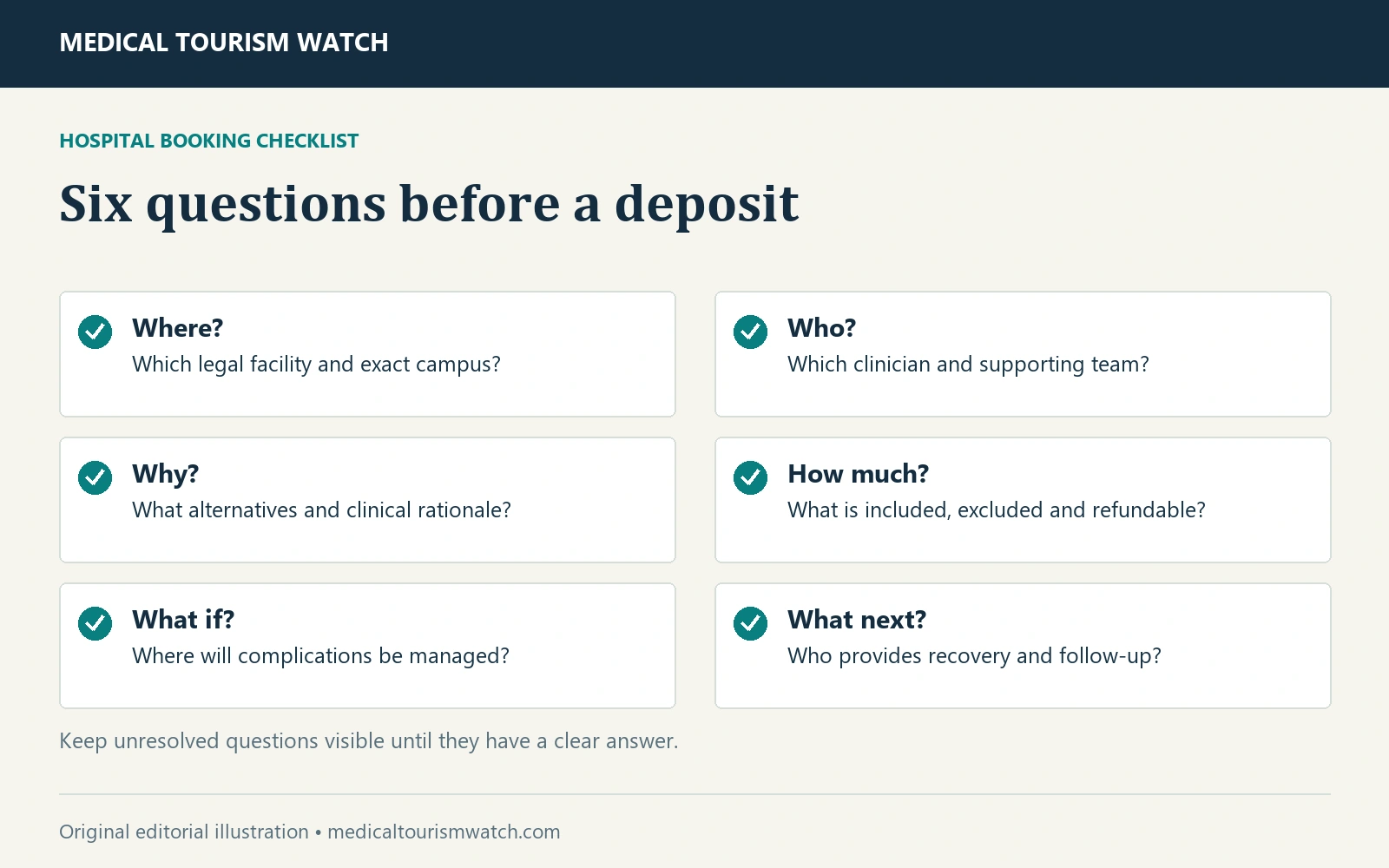
Plan discharge before admission
Agree on who will provide wound checks, rehabilitation, medication monitoring or other follow-up. Obtain that clinician’s agreement rather than assuming a home doctor will automatically undertake specialist aftercare.
Request a discharge summary, procedure report, relevant test results, medication list and device details where applicable. Ask how records will be transferred securely and what translation is available. Keep an accessible copy during travel.
The return date should remain subject to clinical assessment. A package’s number of hotel nights is not proof of fitness to fly. Ask the treating team about the journey, movement restrictions, assistance needs and what symptoms require urgent local assessment. In an emergency, seek local medical care rather than waiting for an overseas messaging service.
When to pause the booking
- The hospital or treating clinician is not identified before payment.
- Licence details, treatment addresses or contract names do not match and the difference remains unexplained.
- The main clinical discussion is delegated entirely to a salesperson.
- The provider promises a risk-free result or refuses to discuss complications.
- There is no workable aftercare plan or written explanation of additional costs.
- A deadline or discount prevents you from obtaining an independent opinion.
These are reasons to resolve uncertainty, not automatic findings that a provider is unsafe. A good decision may be to proceed, choose another facility, seek more information or stay closer to home. The point is to make that decision before financial and travel commitments narrow your options.
A simple way to compare two hospitals
Use the same questions for every shortlisted facility and keep the answers in one document. Mark each answer as confirmed by an independent source, supplied by the hospital or still unresolved. That prevents a detailed marketing presentation from looking more reliable than a shorter but verifiable response.
For example, Hospital A may provide a lower estimate but leave the implant and follow-up undefined. Hospital B may provide a higher estimate, name the device and specify two local reviews. Neither price alone settles the decision. Request the missing details from Hospital A and assess both clinical plans with an independent clinician before comparing the financial commitment.
Keep essential requirements separate from preferences. Appropriate clinical capability, understandable consent and a workable complication plan belong in the first category. Room décor and airport lounge access belong in the second. A score that allows hotel benefits to compensate for an unresolved safety question creates false precision.
Sources and limitations
This guide combines linked public-health guidance, regulator resources and accreditation information with an editorial checklist. It does not certify hospitals or provide a numerical safety score. Registry access, complaint systems and legal protections vary by jurisdiction. For destination context, see the China, Türkiye and Thailand profiles.
Featured photograph: Corridor at NÄL hospital (2018). Illustrative hospital setting; no provider endorsement is implied. Photo: W.carter / Wikimedia Commons, CC0. Resized for publication.


