


Guest post · By Dr. Vitalina Ilyasli, MD
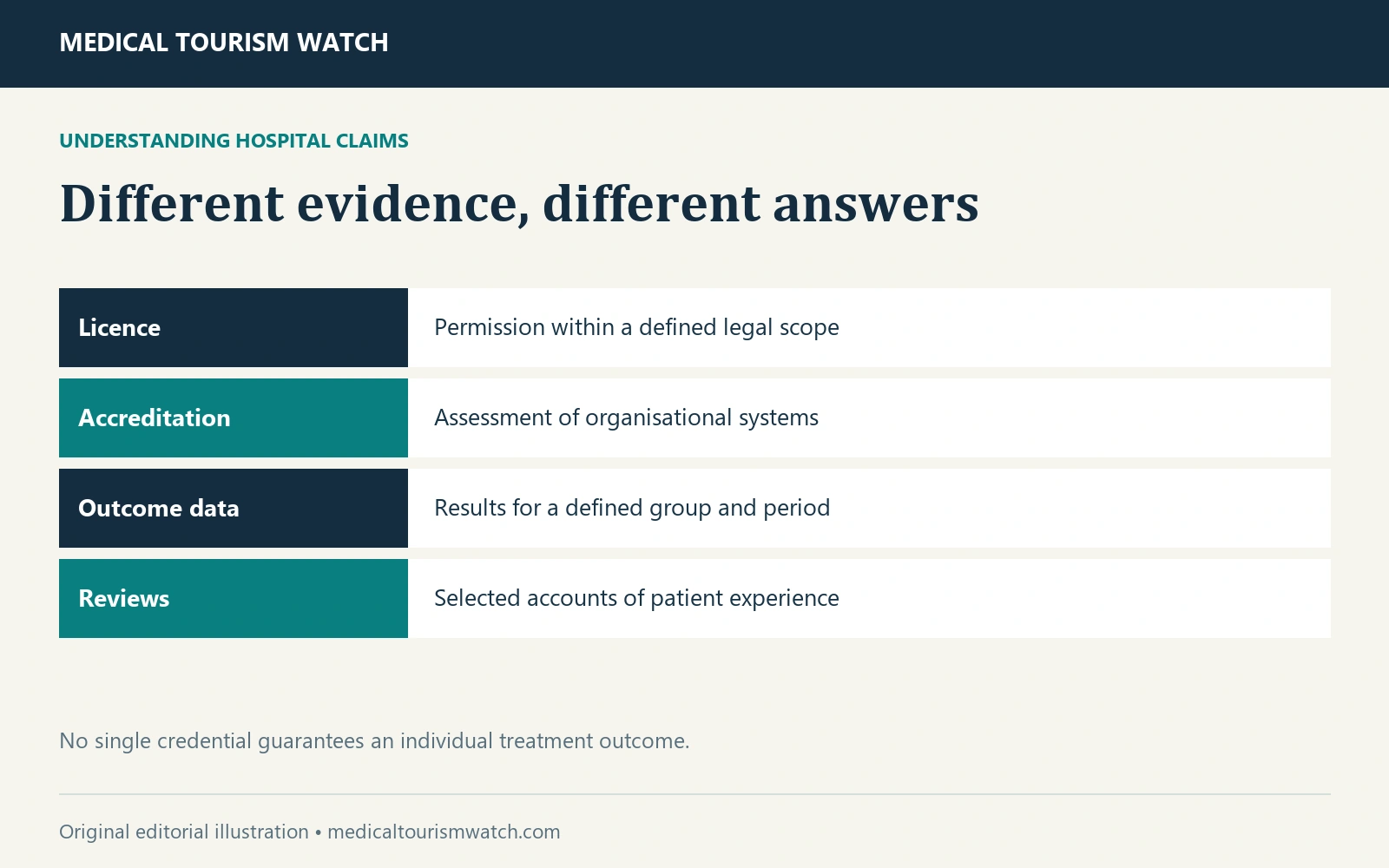
A row of accreditation badges can make a clinic website feel reassuring. As a physician, I see them as a starting point for questions. The useful question is not simply whether a badge looks familiar, but what the issuing organisation has assessed and whether that assessment applies to the facility you will use.
What accreditation can tell you
Healthcare accreditation evaluates an organisation against a defined set of standards. Depending on the programme, it may examine safety processes, infection prevention, medication management, staff qualifications, patient rights and the way the organisation monitors and improves care.
That is valuable evidence about a system. It is not a promise that every patient will have a particular result or that nothing can go wrong.
What you still need to check
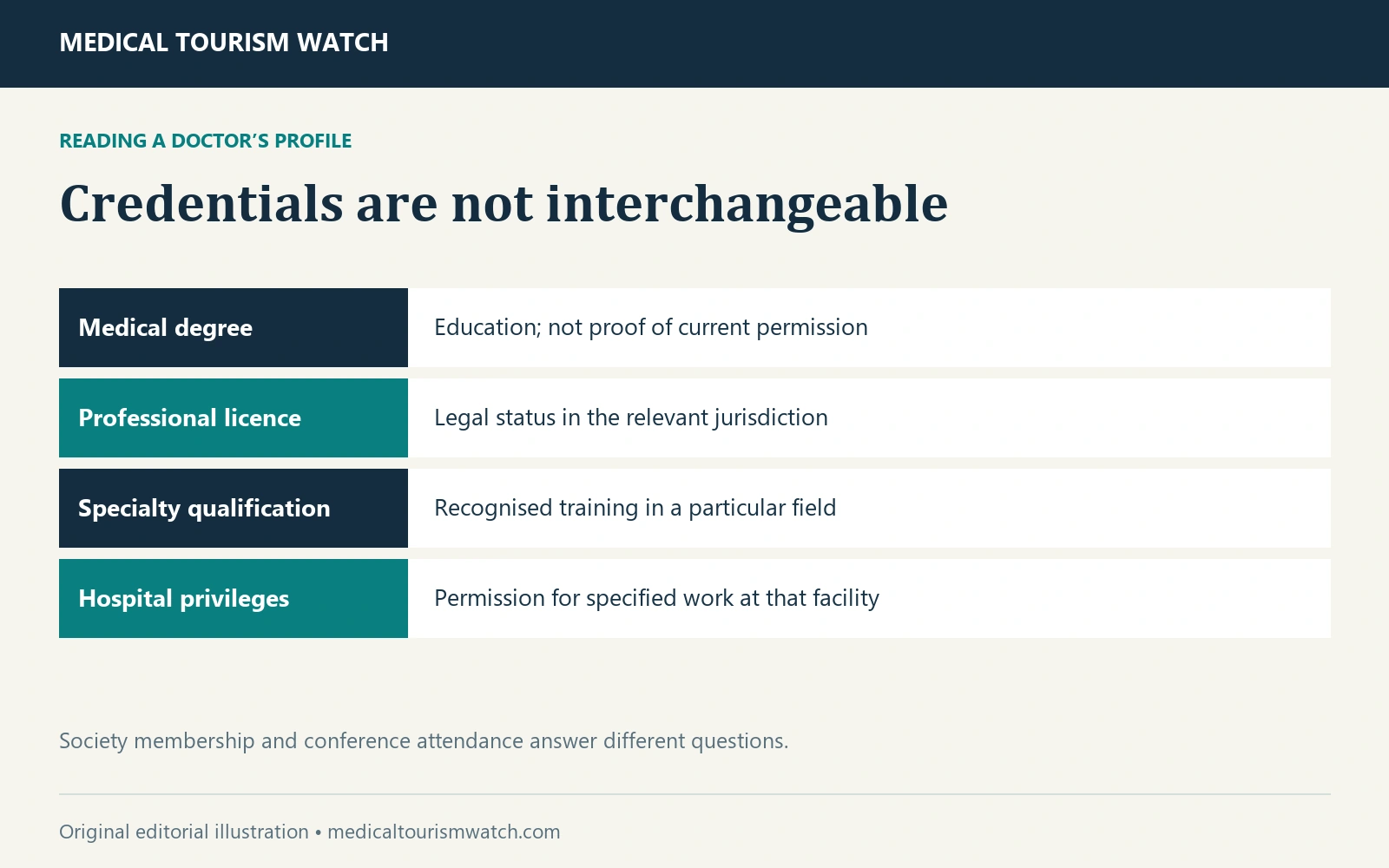
Accreditation does not replace checking the individual clinician’s licence, relevant training and experience with your procedure. It also does not replace a consultation about your own condition, alternatives and expected recovery.
Some accreditation standards address credentialing and informed consent. Even so, a facility’s accredited status cannot establish how well your particular consultation will be conducted. You still need clear answers from the team treating you.
Communication matters too. Two appropriately qualified doctors may explain things differently. You should be able to ask questions, discuss practical constraints and understand the plan without feeling rushed.
Four kinds of badge that should not be confused
- Healthcare accreditation: assessment of a facility or service against the named programme’s standards.
- A facility licence: permission to provide specified services under the relevant jurisdiction’s rules.
- Management-system certification: for example, ISO 9001 concerns a quality management system. It does not certify an individual surgeon or guarantee a treatment outcome.
- Individual credentials and memberships: these concern a person and need their own checks. Membership is not automatically a specialist qualification.
How to verify a claim
- Identify the issuing organisation and visit its official website independently.
- Search its directory for the facility’s exact name and location.
- Check whether the accreditation is current and what dates are shown.
- Confirm the programme and scope, including the relevant site or service.
- Match the legal entity with your treatment documents and ask about any difference.
For a JCI claim, use the official directory of accredited international organisations. For another programme, use that programme’s own records.
If you cannot find a match, ask the clinic and accreditor to clarify. A trading name or recent change may explain a discrepancy. Until it is resolved, do not treat the claim as verified.
Keep the check connected to your treatment
Ask which facility will actually provide care, whether it might change and how you will be told. A certificate for one hospital should not be assumed to cover another branch, an affiliated clinic or every service in a group.
Accreditation is useful when it leads to more precise questions about the doctor, treatment plan and follow-up. It should not end those questions.
Also in this series: The 7 Questions I Ask Before I Trust Any Clinic Abroad.
About the author

Dr. Vitalina Ilyasli, MD is the Chief Medical Officer & Medical Reviewer at Altay Medical Tourism Consulting and a member of the Medical Advisory Board at Medical Tourism Wiki. You can follow Dr. Vitalina on LinkedIn and Instagram.
Further reading selected by the editor: Joint Commission International: Accredited organisations; ISO: Quality management.
Image note: No single credential guarantees an individual treatment outcome. Original illustration prepared for Medical Tourism Watch.
Medical information: This article is for general education and does not replace an individual assessment by a qualified healthcare professional.


