



Guest post · By Dr. Vitalina Ilyasli, MD
Guest contribution: This article presents the author’s perspective. Its publication does not imply that Medical Tourism Watch endorses any clinic, treatment or service.
If I had to choose a clinic abroad for myself or someone close to me, I wouldn’t start by comparing prices or reading reviews. I would ask seven questions. They don’t require a medical education, yet they quickly show where a clinic treats and where it sells. For each one I’ll explain why it matters, what a good answer sounds like, and what should make you pause.
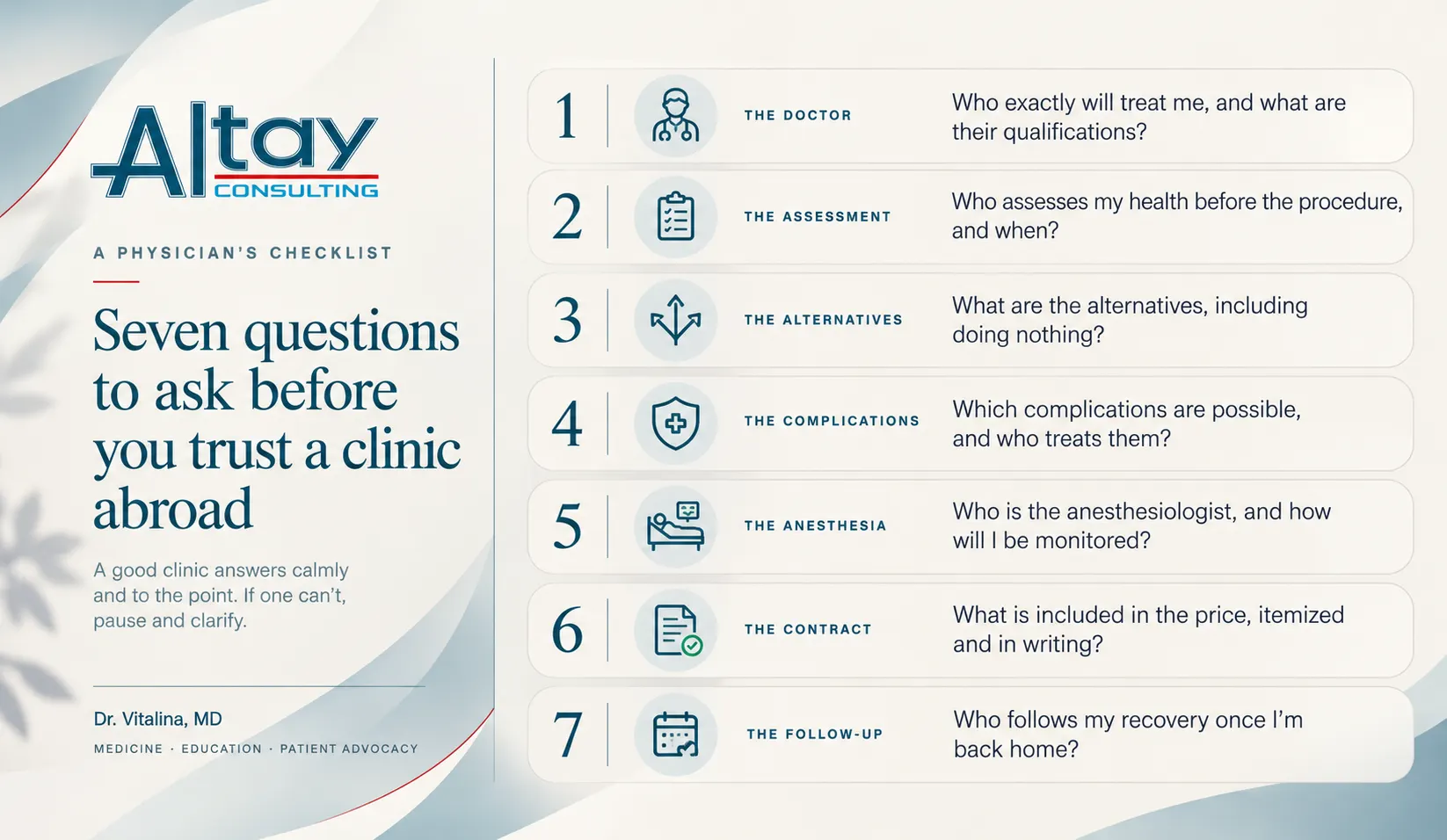
Choosing a clinic abroad is hard because the patient has to decide without being able to compare in person: the language, the country and the healthcare system are all unfamiliar. That fear is legitimate. The idea here is to replace anxiety with questions.
1. Who exactly will treat me, and what are their qualifications?
Why it matters: we judge a clinic by its website, but a specific person operates. You need a name, a specialty, experience with your exact procedure, and documents to confirm it.
A good answer: the doctor is named, and the clinic shows qualifications and examples of their work.
A warning sign: “we have the best surgeons” with no name attached.
2. Who will assess my health before the procedure, and when?
Why it matters: being cleared for an intervention is an assessment of your health: chronic conditions, medications, allergies, test results.
A good answer: you are asked to send your medical history and any required test results in advance, and the clinic explains when you will be assessed, with enough time to discuss the findings before proceeding.
A warning sign: no clinical review before travel, with all questions deferred until the day of surgery.

3. What are the alternatives, including doing nothing?
Why it matters: a good doctor doesn’t just sell an operation; they explain the options, including not intervening at all.
A good answer: you hear the pros and cons of each option.
A warning sign: only one option, plus a discount that expires today.
4. Which complications are possible, and who treats them if they happen?
Why it matters: no operation is free of risk, and it is important to know the plan of action in advance.
A good answer: specific complications are named, and you’re told where, by whom, and at whose expense you’d be treated.
A warning sign: “we never have complications.”
5. Who is the anesthesiologist, and what happens to me under anesthesia?
Why it matters: anesthesia requires appropriately qualified professionals and monitoring suited to the procedure and type of anesthesia.
A good answer: the clinic identifies who will administer your anesthesia and who will monitor you, explains their qualifications and responsibilities, and describes the type of anesthesia and monitoring.
A warning sign: “everything will be fine,” with no details.
6. What is included in the price, and what is written in the contract?
Why it matters: the phrase “all-inclusive” alone does not tell you exactly what a package covers, and extra costs may appear only once you are there.
A good answer: you receive an itemized list and a contract showing what is included, what isn’t, and what happens if complications occur.
A warning sign: the contract is signed on the spot and only in the clinic’s language.
7. Who will follow my recovery once I’m back home?
Why it matters: the biggest questions arise days and weeks after the procedure, when you are already far away.
A good answer: a specific doctor is named for contact, follow-up dates are set, there is a plan for complications, and the clinic can share a discharge summary with your local doctor.
A warning sign: “just message us on WhatsApp.”

The bottom line
A good clinic answers these seven questions calmly and to the point. Even if it can’t answer everything at once, it doesn’t avoid the question and doesn’t pressure you. When there’s no answer to one of them, it doesn’t mean “walk away.” It means “pause and clarify.”
Save-this checklist: 7 questions you can send to a clinic
- Could you tell me who exactly will operate on me, and what that doctor’s qualifications are?
- When, and by whom, will my pre-procedure assessment be done?
- What are the alternatives, including not having the procedure?
- Which complications are possible, and who treats them if they occur?
- Who is the anesthesiologist, and how will I be monitored?
- Could you send an itemized list and the contract in advance?
- Who will follow my recovery after I return home?
About the author
 Dr. Vitalina Ilyasli, MD is the Chief Medical Officer & Medical Reviewer at Altay Medical Tourism Consulting and also a member of the Medical Advisory Board at Medical Tourism Wiki. You can follow Dr. Vitalina on Linkedin and Instagram
Further reading selected by the editor: CDC Yellow Book: Medical Tourism; American Society of Anesthesiologists: Anesthesia Care Team.
Medical information: This article is for general education and does not replace an individual assessment by a qualified healthcare professional.


