



Verifying a doctor abroad requires several separate checks: identity, permission to practise, specialty qualifications, experience and permission to perform the proposed procedure at the named facility.
A doctor’s biography can contain impressive information without answering the question that matters to a patient: is this the right clinician, legally authorised and appropriately supported, to provide this care here?
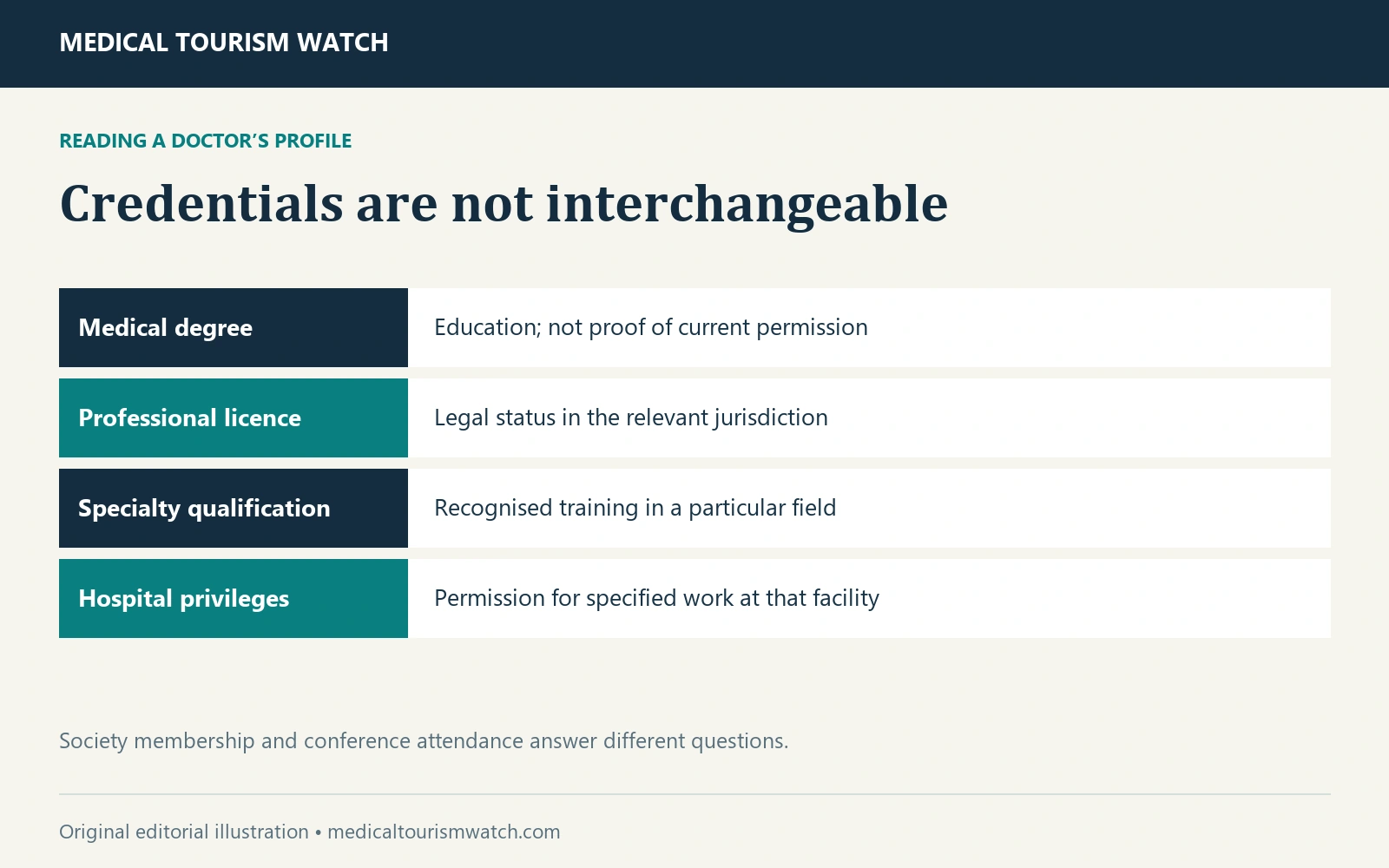
A medical degree, a professional licence, a specialty qualification, a society membership and a hospital appointment are different credentials. Treating them as interchangeable is one of the easiest ways to misunderstand an overseas provider’s claims.
Patient guide · Patient Safety & Ethics · Research updated 17 October 2026. Verification reduces uncertainty; it cannot guarantee an outcome or replace a clinical assessment.
What does it mean to verify a doctor?
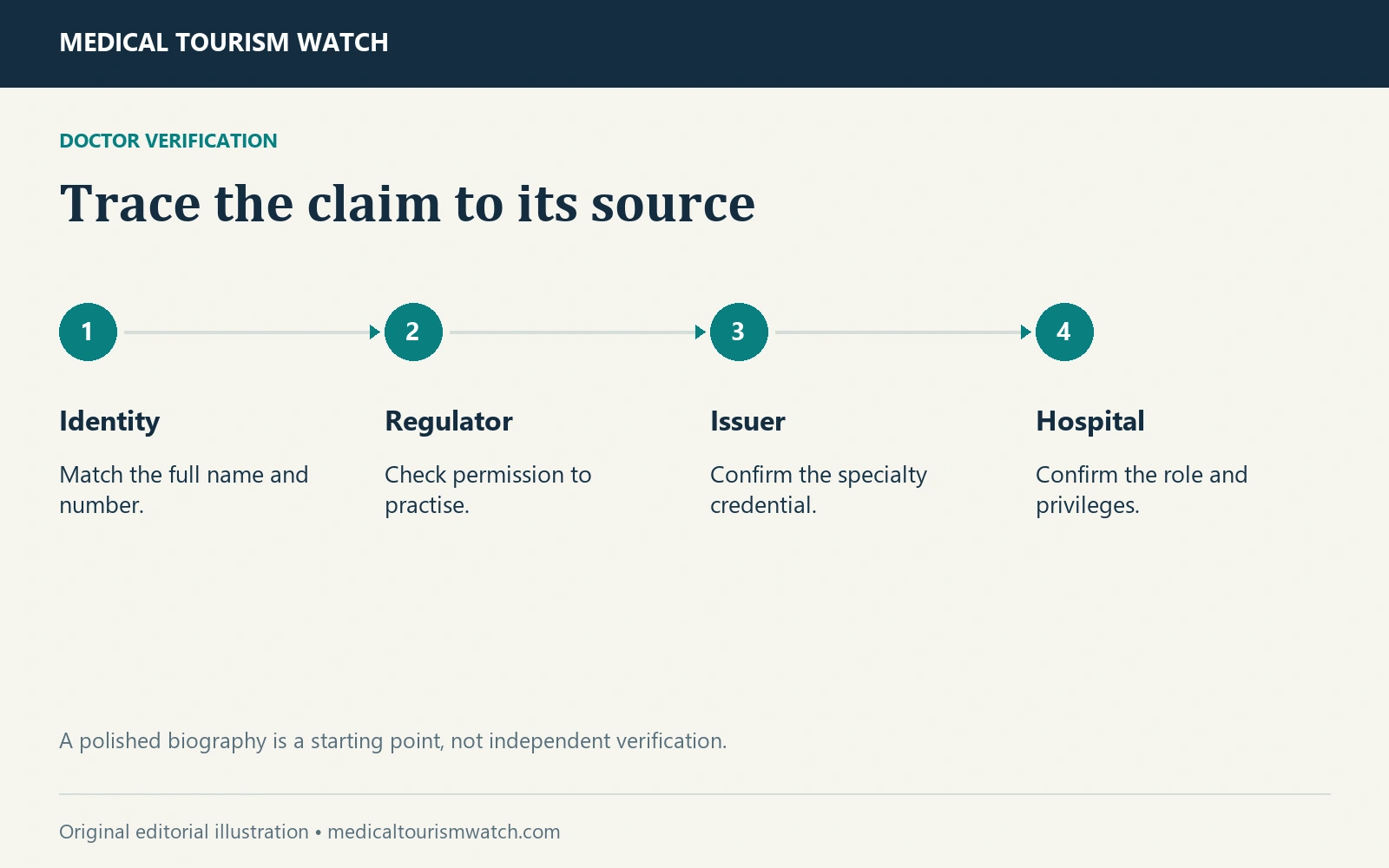
Verification means checking specific claims against the organisations responsible for them. A regulator can provide information about registration. A recognised specialty body can confirm a qualification within its remit. A hospital can confirm an appointment and the procedures a clinician is permitted to perform there.
These sources answer different questions. A hospital biography is a useful starting point, but it should not be the sole evidence for a licence. A degree certificate shows educational attainment; it does not necessarily show a current right to practise. A conference photograph shows attendance or participation, not specialist recognition.
Patients once relied heavily on referrals and institutional reputation to find clinicians abroad. Online profiles now make it easier to compare people, but also easier to repeat a credential without explaining what it means. The practical response is to trace important claims to their issuer.
Start with the doctor’s exact identity
Ask for the full professional name, name in the local script, registration number, regulator and current workplace. Record the proposed role: consulting doctor, operating surgeon, anaesthetist, dentist or another professional. Do not assume the person featured on the clinic’s homepage will deliver the treatment.
Transliterations, name changes and common surnames can complicate a search. A registration number is often a stronger matching tool than an English spelling alone. Compare available details across the regulator, hospital and correspondence.
Confirm the identity through a contact channel you found independently, such as the hospital’s main website. If a coordinator sends a profile, ask the hospital whether the person works there and whether that person is booked for your care. This helps distinguish the doctor’s identity from the identity of whoever is marketing the appointment.
Check the right regulator
Licensing is jurisdiction-specific. A doctor’s registration in one country does not automatically establish authority to practise in another. The relevant question is permission at the place where the proposed treatment will occur.
| Destination or claim | Starting point | What to watch for |
|---|---|---|
| China | National Health Commission information queries | Use the Chinese name and registration details; seek authority clarification if language or search limitations prevent confirmation. |
| Türkiye | Ministry of Health Doctor Information Bank | Diploma-registration verification is not the same as an unrestricted public search of every practice condition. |
| Thailand | Medical Council of Thailand’s physician search | Match the name and licence number; use the separate temporary-licence route where applicable. |
| A claimed UK registration | General Medical Council registers | Check registration, licence and specialist information separately. UK status does not authorise practice elsewhere. |
These are starting points, not a universal international register. Dentists and other health professionals may have different regulators. A physician database should not be used to conclude that a dentist is unlicensed simply because the dentist is absent from it.
The Thai Medical Council’s English search provides a route for active physicians and directs users to contact the Council if a record cannot be found or more information is needed. A failed search warrants follow-up; it is not, by itself, evidence of misconduct.
Understand what the record actually proves
Read the status carefully. Depending on the jurisdiction, a record may show current registration, licence validity, restrictions, suspension or recognised specialties. Some public systems provide only a subset of this information.
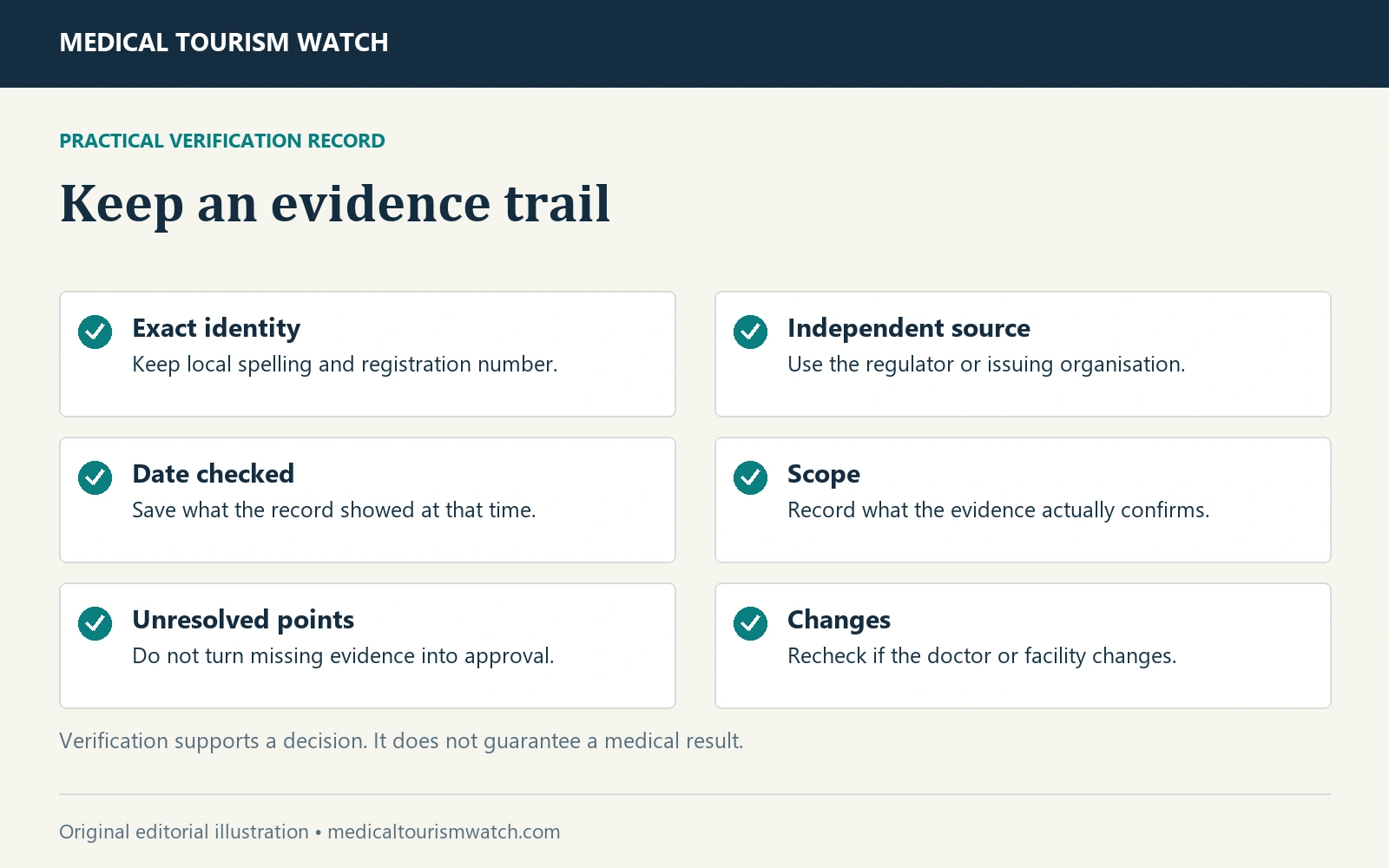
Record the date you checked. A screenshot or PDF is useful evidence of what was visible then, but it is not permanent proof of current status. Recheck close to treatment if considerable time has passed or the proposed doctor changes.
Türkiye’s Ministry of Health has described a Doctor Information Bank verification-key process through which professionals can share diploma-registration information. If access requires cooperation from the clinician, request the appropriate verification document or seek help from the relevant provincial health authority. Do not treat a login barrier as a clean bill of health.
Similarly, absence of a publicly displayed disciplinary history is not proof that no concerns have ever existed. Ask the regulator what information it can disclose and what a particular status means. Do not infer malpractice from an unexplained search result.
Check the specialty qualification
Ask for the exact specialty, awarding body, country and date of qualification. A general medical licence and a recognised specialist qualification are not the same thing. Words such as “aesthetic expert,” “international specialist” or “cosmetic doctor” may be descriptive marketing rather than a regulated specialty title.
If the clinician claims board certification, identify which board and whether it is recognised in the relevant system. Verify the credential through the issuing body where possible. Do not assume that a short course, fellowship, observership and full specialty training have equivalent requirements.
The GMC’s explanation of its Specialist Register illustrates why terminology matters: specialist status is a distinct part of the UK system. Other countries organise specialist recognition differently, so UK terminology should not simply be imposed on another jurisdiction.
A useful request is: “Please tell me which recognised qualification prepares you for this procedure and which organisation can confirm it.” That asks for verifiable information without assuming that every country uses the same professional titles.
Confirm procedure-specific experience
A relevant qualification is a foundation, not a complete assessment of suitability. Ask about recent experience with the exact procedure, particularly if yours involves revision surgery, a complex medical history or a specialised technique.
Clarify whether case numbers refer to the individual doctor or the wider clinic. Ask what role the doctor played. Assisting, supervising and performing a procedure are different activities, even when all contribute to experience.
Request an explanation of how outcomes are measured and which problems are tracked. “Success” might mean technical completion, a clinical improvement or patient satisfaction. Ask about the period of follow-up, the number of patients included and whether outcomes are independently reviewed.
No single minimum case count applies sensibly to every specialty and procedure. A patient should not convert a self-reported number into a safety rating. An independent clinician familiar with the treatment can help interpret what experience and support are relevant.
Verify hospital privileges and the wider team
Hospital privileges are the facility’s permission for a clinician to undertake specified activities there. Ask the hospital to confirm that the doctor is authorised for your proposed procedure at the exact location where it will occur.
An affiliation listed in a biography may mean employment, visiting practice, previous work or an academic relationship. Ask which applies now. A famous hospital’s logo should not substitute for confirmation.
Identify the other professionals involved. For surgery, ask who handles anaesthesia, inpatient reviews and complications. For a dental restoration, ask who plans the treatment, performs surgery if needed and fits the final prosthesis. For a hair transplant, ask who performs each clinical step and how those roles are supervised and authorised.
The aim is not to insist that one doctor performs every task. It is to understand the allocation of responsibility. A team can be appropriate and effective when roles are clear; an unnamed team makes informed assessment difficult.
Use the consultation as a separate check
Credential checks cannot establish whether a clinician listens, understands your history or gives a balanced account of treatment. A substantive consultation should address your goals, relevant medical history, options, limitations and the possibility that the requested procedure is not suitable.
Ask what additional examination or tests are needed before the plan becomes final. A remote discussion can support preparation, but it may not replace an in-person assessment. Be cautious if a definitive treatment plan is issued from photographs alone when a proper examination is needed.
The NHS advice on choosing a cosmetic surgeon abroad emphasises training, qualifications, experience, language and direct consultation. A salesperson’s reassurance cannot answer the clinical questions that belong to the treating doctor.
If an interpreter is needed, establish who provides the service and whether the clinician can communicate through that person throughout consent and follow-up. Understanding a greeting or discussing travel arrangements in English is not evidence that complex medical communication will be adequate.
Use reviews and photographs as limited evidence
Reviews can reveal useful questions about communication, waiting times, billing or support. They rarely provide a reliable denominator for complications. Patients with excellent or poor experiences may be more likely to post than those with ordinary outcomes.
Before-and-after photographs should be interpreted cautiously. Ask whether they show the clinician’s own patients, how long after treatment they were taken and whether lighting, position and editing are consistent. A selected photograph cannot predict your result.
Professional society membership can be checked with the society, but first understand the membership criteria. Attendance at a meeting or payment of a membership fee may mean something different from examination-based specialist recognition. An honest biography should make the distinction clear.
Ask about insurance, records and responsibility
Request information about the clinician’s professional indemnity or liability cover and how an overseas patient can raise a concern. Do not assume insurance guarantees compensation or that every treatment is within the policy’s scope. Ask for clarification when the policyholder, clinic name and contracting entity differ.
Find out who will hold the medical record and how you can obtain it. The doctor’s name, procedure details and relevant findings should be documented in the clinical record, not only in a coordinator’s messages.
Ask who provides follow-up if the clinician leaves the clinic, is unavailable or changes the operating schedule. If a replacement is proposed, repeat the identity, licence, specialty and privileges checks. Consent to treatment by one named clinician should not be treated as a blank agreement to any substitute.
A practical verification sequence
- Identify: obtain the full name, local spelling, registration number and intended role.
- Confirm legal status: check the relevant regulator and resolve ambiguous results.
- Confirm specialty: trace the claimed qualification to its recognised issuer.
- Confirm the setting: ask the named hospital about the clinician’s current appointment and privileges.
- Assess the plan: discuss the proposed treatment, alternatives, risks and follow-up directly with the clinician.
- Document: save dated verification evidence and obtain the agreed plan in writing.
Keep an “unresolved” category. A claim that has not been checked should not quietly become a verified fact because other parts of the profile look convincing. If important questions remain unanswered, postpone a non-urgent commitment while seeking clarification.
What verification cannot tell you
Even complete credentials cannot guarantee a complication-free result, establish the quality of every team member or predict how your condition will respond. Equally, a modest online presence does not prove a clinician lacks skill.
The final decision combines verified status, relevant expertise, the clinical plan, the facility’s capability and a workable recovery arrangement. Use this guide alongside Choosing a Hospital Abroad, rather than treating either as a stand-alone certificate of safety.
Example: a profile that needs clarification
Suppose a clinic describes a surgeon as “internationally trained and board certified” and displays a foreign hospital logo. The next step is to identify the board, the training programme and the current relationship with that hospital. A short visiting placement may be accurately described as overseas experience while still being very different from completing specialty training there.
If the doctor provides a current local registration number, a verifiable specialist qualification and confirmation of privileges at the proposed treatment site, those checks resolve specific questions. They do not authenticate unrelated advertising claims or guarantee the proposed result. Keep the consultation and treatment assessment as separate parts of the decision.
If an important credential cannot be verified, explain precisely what remains uncertain when seeking another opinion. “I could not confirm this claimed specialty qualification” is more accurate and useful than either declaring the doctor unsafe or accepting the entire profile on trust.
Sources and scope
The linked regulator pages establish verification routes and the meaning of selected credentials; the remaining checklist is an editorial framework for questions to ask. No individual doctor has been investigated or endorsed here. Country procedures and public access can change, and clinical, legal or insurance questions may require advice specific to your circumstances.


